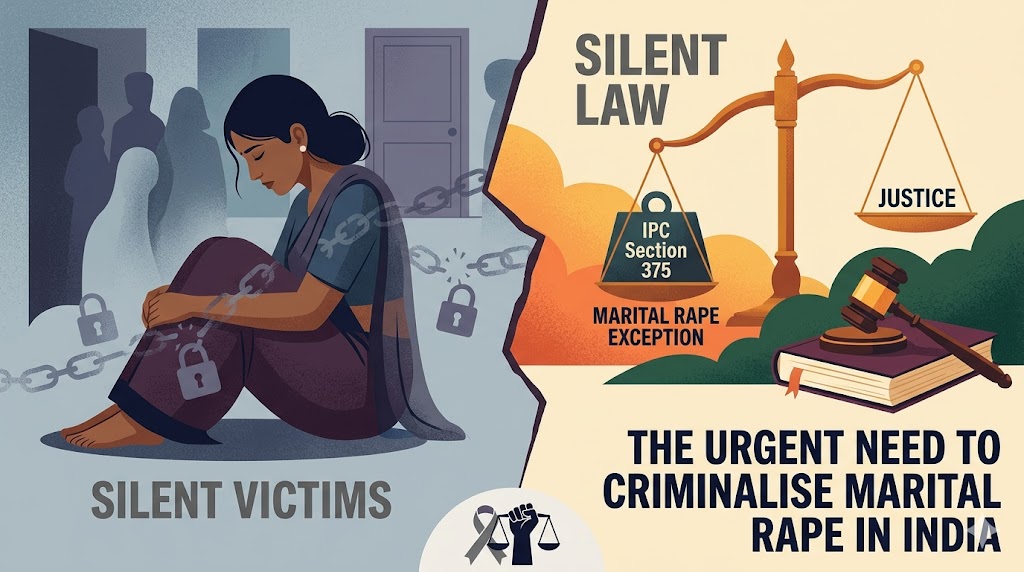
Published on: 14th December 2025
Authored by: Piyush Tiwari
Adv. Balasaheb Apte College of Law, University of Mumbai
COURT: SUPREME COURT OF INDIA
YEAR: 2017
CITATION: (2017) 10 SCC 8001
Introduction
On 11th October 2017, a landmark judgment was pronounced by the Supreme Court in which the court held that exception 2 of Section 375 of the Indian Penal Code, 1860 (IPC) is by itself an arbitrary provision, and stated that a husband cannot have sexual intercourse with his wife if she is between 15 to 18 years of age even with her consent. It brought about a major change in Indian law and society. This judgment extended its protection to young girls who are forced into child marriages and are subject to mental and physical abuse by their husbands, reinforces the fundamental rights of girl children and safeguards the bodily integrity of every girl child.
Facts of the Case
The petitioner is a non-profit organization and society registered on August 6, 2009, actively involved in protecting child rights. He filed a writ petition in the Supreme Court under Article 32 of the Constitution of India in the nature of public interest litigation in 2013. Respondent is the union of India and National Commission for women
The society wanted to contest Section 375 IPC’s Exception 2, which they felt hurt young girls and violates Article 14,15 and 21. Contesting Section 375 IPC’s Exception 2: Exception 2 to Section 375 of the Indian Penal Code, 1860, was the specific object of the petition. This provision excluded them from the usual protections afforded to children by decriminalizing sexual relations between a husband and his wife if she was between the ages of 15 and 18.
According to the petitioner, Section 375 of the IPC defines sexual intercourse with a girl below 18 years of age as rape, irrespective of consent. However, under Exception 2, if such a girl is married, her husband’s act of non-consensual sexual intercourse is exempt from criminal liability merely due to the existence of the marital relationship. This discriminatory exemption, the petitioner argues, effectively denies protection to a significant group of minor girls and runs contrary to both the spirit and purpose of the law.
Legal Issues
Critical issues raised by the petition are as follows:
- Whether Exception 2 to Section 375 IPC violates Article 21 by prescribing a lower age of consent for married girls?
- Whether Exception 2 to Section 375 IPC violates Article 14 by discriminating between married and unmarried minor girls in cases of sexual violence? 3. Whether Exception 2 to Section 375 IPC can go against the age of consent universally fixed by the Parliament at 18 years for girls in all other statutes?
Court’s Decision
- The Supreme Court held that exception 2, relates to the girl child below eighteen years, is unreasonable, unjust, unfair and violative of the rights of the girl child. To that extent the same is arbitrary and liable to be set aside.
- Also, exception 2 in so far as it relates to girls below 18 years is discriminatory and violative of Article 14 of the Constitution of India.
- There can be no doubt that by partly striking down Section 375 of IPC, no new offence is being created. The offence already exists in the main part of Section 375 of IPC and Section 3 and 5 of The Protection of Children from Sexual Offences Act, 2012 (POCSO).
- Since this Court has not dealt with the wider issue of “marital rape”, exception 2 to Section 375 of IPC should be read down to bring it within the four corners of law and make it consistent with the Constitution of India.
- Exception 2 to Section 375 IPC in so far as it relates to a girl child below 18 years, is liable to be struck down on the following grounds: –
- It is arbitrary, capricious, whimsical and violative of the rights of the girl child and not fair, just and reasonable and, therefore, violative of Article 14, 15(3) and 21 of the Constitution of India.
- It is discriminatory and inconsistent with the provisions of POCSO, which must prevail.
- Additionally, the Court recognized that the right to life encompasses the right to physical, mental and economic development as an independent adult. It noted the harmful effects of child marriage and early childbirth on a girl’s health, reinforcing that Exception 2 debilitated the girl child and violated her rights under Articles 14, 15 and 21.
- Although the Court in Independent Thought v Union of India considered whether Exception 2 violated the right to privacy as established in K.S. Puttaswamy vs. Union of India, it refrained from directly addressing this issue to avoid broader implications on marital rape laws.
Legal Reasoning
Majority Opinion (Justice Madan B. Lokur & Justice Deepak Gupta)
Held by Majority (2–0):
- Exception 2 of Section 375 IPC, which allowed marital sex with a wife aged 15–18, was struck down.
- The Court held that sexual intercourse with a wife below 18 years of age constitutes rape, regardless of marriage.
The Supreme Court declared that engaging in sexual relations with a wife who is below 18 years of age amounts to rape, even if the marriage is recognized under personal or customary law. The Bench observed that the exception contained in Section 375 of the Indian Penal Code (IPC) was unjust, discriminatory, and inconsistent with the fundamental rights guaranteed by Articles 14, 15, and 21 of the Constitution.
Delivering the principal opinion, Justice Madan B. Lokur remarked that the law drew an irrational line between a married and an unmarried girl child. Although both are minors, only the married girl was deprived of protection against sexual assault. The Court found this distinction to be incompatible with the spirit of a constitutional democracy committed to safeguarding the rights and dignity of children.
The judges further marked that the challenged exception was in direct contradiction with existing child protection statutes-most notably the Protection of Children from Sexual Offences Act, 2012 (POCSO), which criminalizes all sexual activity involving persons under 18 years of age. It also conflicted with the Prohibition of Child Marriage Act, 2006, which aims to prevent and penalize child marriages.
Justice Lokur underscored the importance of interpreting the law in a manner that promotes the dignity, autonomy, and bodily integrity of young girls. The Court firmly rejected the notion that marriage could be used as a defense to legitimize sexual activity with minors.
Consequently, the Court read down Exception 2 to Section 375 IPC, holding that sexual intercourse with a wife below the age of eighteen years constitutes rape within the meaning of the Penal Code.
There was no dissenting opinion in this case; both judges agreed on the decision. Key Statutes Referred to in the Judgment
1. Indian Penal Code, 1860 (IPC)
- Section 375 (Rape) – defines the offence of rape.
- Exception 2 – excluded sexual intercourse with one’s wife, provided she was not under 15 years of age.
2. Protection of Children from Sexual Offences Act, 2012 (POCSO)
- Defines a child as person below 18 years.
- Criminalizes all sexual acts with minors, regardless of consent or marital status. c. The Court noted that Exception 2 of Section 375 directly conflicted with the POCSO Act. 3.Prohibition of Child Marriage Act, 2006 (PCMA)
- Declares child marriage as an offence and provides for its abolishment.
- The Court held that the IPC exception undermined the purpose of this law by indirectly forgiving sexual relations within child marriages.
3. Juvenile Justice (Care and Protection of Children) Act, 2015
- Ensures care, protection, and rehabilitation of children in need.
- Cited to reinforce that the State has an obligation to safeguard children’s rights and development.
4. Constitution of India
Article 14 – Right to Equality.
Article 15 – Prohibition of discrimination, including on the ground of sex.
Article 21 – Right to life and personal liberty, which includes dignity, bodily integrity, and sexual autonomy.
Impact –
- Protection of Child Rights.
- Challenging Child Marriage.
- Bodily Integrity and Health
- Triggered Marital Rape Discourse.
- Empowerment of Girls.
- Harmonization of Law.
Conclusion
In this case the Supreme Court struck down exception 2 to Section 375 of IPC and held that the provision is arbitrary since it is violative of the principles enshrined in Article 14, 15 and 21 of the Constitution of India.