Published on: 24th December, 2025
Authored by: RAMYA. V
Sastra Deemed University
Abstract
Freedom of speech is a cornerstone right under the Indian Constitution, embodying the nation’s democratic ethos. However, with the increasing misuse of speech—particularly in the age of the internet and social media—the distinction between protected expression and hate speech has become contentious. This article critically examines the legal framework regulating free speech and hate speech in India, assesses major judicial interpretations, and evaluates whether India has achieved an appropriate balance between liberty and social harmony.
I. Introduction
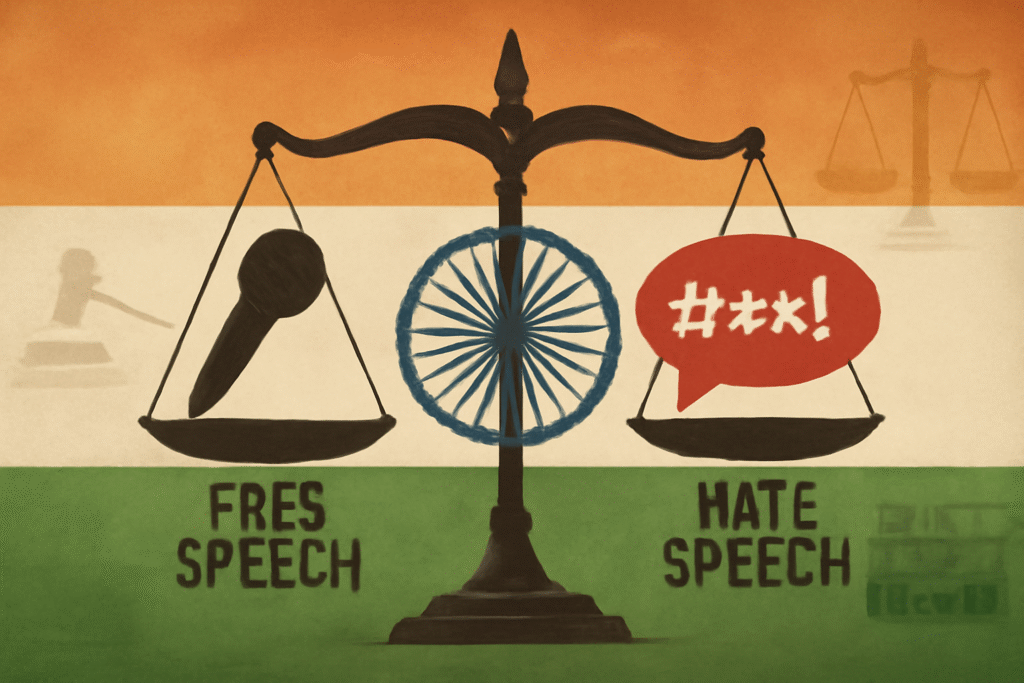
India, the world’s largest democracy, is founded on the principles of freedom of expression and the free exchange of ideas. Article 19(1)(a) of the Indian Constitution guarantees the fundamental right to freedom of speech and expression.[1] This freedom, however, is not absolute. Article 19(2) permits reasonable restrictions in the interests of sovereignty, public order, decency, and morality.[2] The paramount challenge today lies in regulating and interpreting hate speech without infringing upon constitutionally guaranteed free speech rights.
As communal tensions escalate, political polarization intensifies, and online radicalization proliferates, hate speech increasingly threatens to undermine India’s constitutional ethos. The challenge lies in establishing clear legal boundaries between permissible criticism and prohibited incitement to hatred without descending into censorship or arbitrary enforcement.
II. Constitutional Framework: Freedom and Restraints
A. Article 19(1)(a): The Right to Freedom of Speech
Article 19(1)(a) of the Constitution ensures that all citizens possess the right to freely express their opinions, thoughts, and views. This encompasses:
– Political speech
– Artistic expression
– Academic freedom
– Media freedom
B. Article 19(2): Reasonable Restrictions
Freedom of speech is not absolute. The State may impose reasonable restrictions on the basis of:
– Sovereignty and integrity of India
– Security of the State
– Public order
– Decency or morality
– Contempt of court
– Defamation
– Incitement to an offence
Consequently, hate speech that endangers public order or promotes communal hatred may be restricted under Article 19(2).
III. Defining “Hate Speech” in the Indian Context
India lacks a comprehensive statutory definition of hate speech. However, several provisions of the Indian Penal Code, 1860 (IPC), along with judicial pronouncements, delineate the contours of hate speech.
A. IPC Provisions Relating to Hate Speech:
1. Section 153A – Promoting enmity between different groups on grounds of religion, race, place of birth, residence, language, etc.[3]
2. Section 295A – Deliberate and malicious acts intended to outrage religious feelings of any class[4]
3. Section 505(1) & 505(2) – Statements conducing to public mischief[5]
4. Section 124A – Sedition (though subject to significant judicial scrutiny)[6]
These provisions penalize speech that incites violence, promotes communal disharmony, or deliberately outrages religious sentiments.
B. Judicial Definitions:
In Pravasi Bhalai Sangathan v. Union of India (2014), the Supreme Court observed that hate speech includes any communication that denigrates a person or group based on characteristics such as race, religion, ethnicity, gender, or nationality.[7]
IV. Judicial Approach to Balancing Free Speech and Hate Speech
The Indian judiciary has demonstrated considerable prudence in balancing the protection of free speech against the need to restrict hate speech.
A. Shreya Singhal v. Union of India (2015)
The Supreme Court struck down Section 66A of the Information Technology Act, 2000, as unconstitutionally vague and excessively restrictive of free speech.[8] The Court established a crucial distinction between “discussion” and “advocacy” (which are protected) versus “incitement” (which is not protected). The judgment emphasized that speech may be restricted only when it creates a clear and present danger of inciting imminent violence.
B. S. Rangarajan v. P. Jagjivan Ram (1989)
The Court held that in a democracy, “freedom of expression cannot be suppressed on account of threat of demonstration and processions or threats of violence.”[9] Any restriction must demonstrate an immediate and proximate nexus with the apprehended danger to public order.
C. Amish Devgan v. Union of India (2020)
The Supreme Court reiterated that hate speech is not constitutionally protected and emphasized that both the intent behind speech and its actual or potential effect are critical factors in determining its legality.[10]
V. Challenges of the Digital Age: Social Media and Hate Speech
Social media platforms have exponentially amplified both the reach and impact of hate speech. The viral nature and anonymity of online communication present unprecedented challenges for legal regulation.
A. Information Technology (Intermediary Guidelines and Digital Media Ethics Code) Rules, 2021:
The IT Rules 2021 impose significant obligations on intermediary platforms to:[11]
– Remove or disable access to unlawful content within specified timeframes upon government or court order
– Appoint designated grievance officers
– Exercise due diligence in monitoring objectionable content, including hate speech
However, these regulations have been criticized as potential instruments of government overreach and undue restriction on free speech.
B. The Role of Intermediaries:
Online platforms operate in a complex space between protecting user expression and complying with state mandates. The absence of clear, consistent legal standards for identifying and regulating hate speech online creates opportunities for inconsistent enforcement and potential abuse.
VI. Comparative Perspective: International Hate Speech Jurisprudence
Examining international approaches to hate speech regulation offers valuable insights for India’s evolving legal framework.
A. United States:
The First Amendment to the U.S. Constitution provides robust protection for free speech, including most hate speech, unless it incites imminent lawless action.[12] The standard established in Brandenburg v. Ohio (1969) sets an exceptionally high threshold for speech restrictions.
B. Germany:
Germany criminally prohibits hate speech, Holocaust denial, and the display of Nazi symbols as safeguards against the resurgence of fascist ideology.[13] This reflects Germany’s particular historical context and commitment to preventing extremism.
C. United Kingdom:
The UK balances free expression with comprehensive legislation against racial, religious, and homophobic hatred under the Public Order Act 1986 and subsequent amendments.[14]
India’s approach occupies a middle ground between the highly permissive American model and the more restrictive European frameworks.
VII. Legislative Gaps and the Need for Reform
Despite various IPC provisions addressing hate speech, India lacks a comprehensive, well-defined, and contemporary legislative framework specifically addressing this issue.
A. Law Commission Recommendations:
The 267th Report of the Law Commission of India (2017) recommended introducing new Sections 153C and 505A to the IPC to define and punish hate speech with greater specificity and clarity.[15] However, these proposed reforms have not been enacted into law.
B. The Need for Legislative Clarity:
The IPC’s current provisions employ vague terminology (such as “outraging religious feelings”) that invites misuse and arbitrary application. A modern legislative framework should:
– Provide a precise, workable definition of hate speech
– Incorporate intent-based criteria for determining culpability
– Include robust procedural safeguards against abuse
– Address the unique challenges posed by digital and social media platforms
VIII. Conclusion
Freedom of expression constitutes the backbone of democratic governance—but it must not be weaponized to divide communities and incite hatred. India must navigate the delicate path between protecting civil liberties and preventing polarizing, hateful propaganda.
While the judiciary has consistently upheld the right to dissent and criticism, it has simultaneously refused to tolerate incitement to violence or hatred. The current moment demands a balanced legal regime that clearly defines hate speech, ensures fair and consistent enforcement, and safeguards constitutional morality.
Ultimately, legislative reform, judicial vigilance, and responsible conduct in digital spaces must work in concert to uphold India’s democratic values where freedom and fraternity coexist in mutual respect.
References
[1] INDIA CONST. art. 19, cl. (1)(a).
[2] INDIA CONST. art. 19, cl. (2).
[3] Indian Penal Code, 1860, § 153A, No. 45 of 1860, INDIA CODE.
[4] Indian Penal Code, 1860, § 295A, No. 45 of 1860, INDIA CODE.
[5] Indian Penal Code, 1860, §§ 505(1), 505(2), No. 45 of 1860, INDIA CODE.
[6] Indian Penal Code, 1860, § 124A, No. 45 of 1860, INDIA CODE.
[7] Pravasi Bhalai Sangathan v. Union of India, (2014) 11 SCC 477
[8] Shreya Singhal v. Union of India, (2015) 5 SCC 1
[9] S. Rangarajan v. P. Jagjivan Ram, (1989) 2 SCC 574
[10] Amish Devgan v. Union of India, (2020) 19 SCC 753
[11] Information Technology (Intermediary Guidelines and Digital Media Ethics Code) Rules, 2021, Ministry of Electronics and Information Technology, Government of India.
[12] U.S. CONST. amend. I.
[13] Strafgesetzbuch [StGB] [Criminal Code], Nov. 13, 1998, BUNDESGESETZBLATT, Teil I [BGBL. I] at 3322, §§ 86, 130 (Ger.).
[14] Public Order Act 1986, c. 64, §§ 17-29 (UK).
[15] LAW COMMISSION OF INDIA, REPORT NO. 267, HATE SPEECH (2017).