Published On: 14th February 2026
Author(s): Saksham Srivastava & Kartiki Ramesh
Institute of Legal Studies, Shri Ramswaroop Memorial University, Lucknow
Abstract:
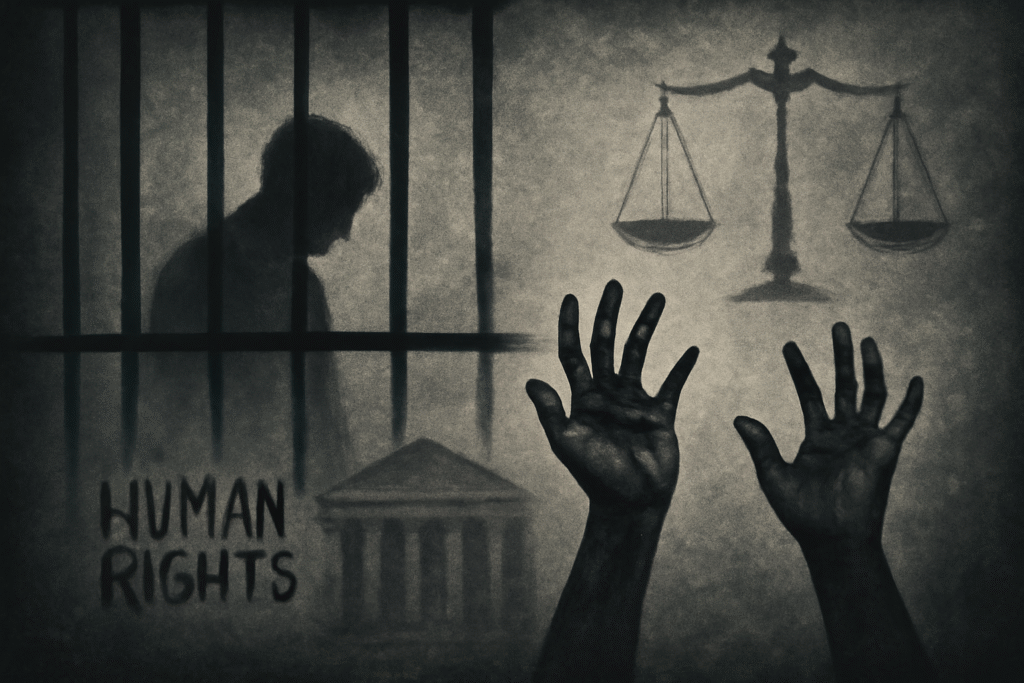
Rule of law stays also a pillar of the democratic society since it involves laws that regulate the state instead of the whims of the individuals. It reflects the ideals of the equality before the law, responsibility, legal certainty and the access to justice. This paper expounds on the core of the rule of law & outlines its importance in the maintenance of democracy with some examples in the world showing both its weaknesses and strengths.
Introduction:
Democracy does not simply entail the free and fair elections. It is also concerning what follows the said elections. It is about the way individuals, in authority employ that authority and the way they are prevented in doing things. By ensuring that there are laws that should be adhered to by everyone it is one of the vital ways of making sure that the government does not get too powerful. The rule of law infers that all people including the government should be subject to the law and be accountable to its law. The rule of law and democracy are extremely significant. It is the rule of law that prevents the government to do as it pleases. It ensures that the rules have to be adhered to by the government and other persons. The British Constitution has some principles and the rule of law is a part of them A.V. Dicey, a constitutional scholar stated that rule of law is very important. The rule of law indicates that regular laws are more powerful than power. It also means that everyone is equal when it comes to the law. The British Constitution is based on the regulation of the land. The rule of law is what makes sure that the British Constitution is fair and just. A.V. Dicey believed that the rule of law is essential, to the Brits Constitution.
The rule of law has also become a focus of strengthening in the last few years, with the help of international organizations such as the United Nations. The rule of law is a concept of government under which every individual, every institution and every entity, according to the report by UN Secretary-General in 2004, is liable to laws that openly proclaimed, equally applied and adjudicated through independent courts.
Core Principles of the Rule of Law:
- Equality Before the Law: The real democracy is not easy-going to discernment. Every person is entitled to equivalent protection under the law, irrespective of his race, gender, social class, and political belief.
- Legal Certainty and Clarity: To have laws that are respected, the laws must be pure/clear, unchangeable, and predictable. Citizens ought to be in a position of predicting the legal ramifications of their activities.
- Responsibility of Government Officials: The rule of law demands that the government officials act within the limits of law. This makes sure that the officials of the society are not able to exercise power at their own whims.
- Access to Justice: The citizens should be able to access means through which they can exercise their legal rights and resolve conflicts in a fair and effective manner.
- The Autonomous Judiciary: The courts should not be politicized but should be exercised without favoritism of the law. The judiciary has to be independent to check the power of the government through the interpretation and enforcement of laws.
- Openness in the Legal Process: The laws and legal processes should be made public and comprehensible. Such a clear nature increases public self-assurance and validity.
The Role of Rule of Law in a Democracy:
The rule of law is vital for the working of a democratic government. Its implication can be understood through the following lenses:
- Guarantee of Basic Rights: The rule of law is a guarantee on civil liberties and human rights. By interpreting the constitution, courts promote the rights of the citizens, including the freedom of speech, the freedom of religion, and the right to the privacy. The ruling of the Supreme Court in Maneka Gandhi v. in India. Article 21 was expanded in Union of India (1978) to make it clear that no one shall be denied life or personal liberty except under the procedure laid down by law.
- In Democracies, the legislative, judiciary, and the executive are separated, and there are checks and balances. These branches are not allowed to overstep their mandate through the rule of law. As an illustration, the courts can overview the executive actions and invalidate them in case they are contrary to the constitution.
- Prevention of Tyranny and Corruption: An open and responsible legal system will demotivate dictatorial attitude and abuse of authority. Democratic values are upheld when leaders are brought to book in court.
- Legitimacy and Public Confidence: When individuals consider the law system to be just and equitable, it creates confidence in the institutions in society. This faith is essential in the political stability and social cohesion.
Global Perspectives and Challenges:
- Good Rule of Law: It is always said that such countries as Sweden, Canada and Germany have the high score in the Rule of Law Index by the World Justice Project. These countries possess strong legal systems, autonomous courts and high level of confidence of the people to legal systems.
- Rule of Law erosion: Nonetheless, such standards have not been maintained in every democracy. The Roman-Dutch-French-Polish judicial reforms that the ruling party in Poland has initiated have been criticized to compromise the liberation of the judiciary raising the apprehension of the European Union. The on-goings political interference with the anti-corruption investigations in Brazil have cast doubt on the objectivity of the justice structure in the country.
- Emerging Democracies: In certain third world countries, the rule of law cannot be fully realized because of poor legal institutions and dishonesty, which prevent the full application of the rule of law.
Conclusion:
The rule of law is not fair a legal concept but a basic democratic principle which safeguards rights, restrains authority and simplifies justice. Without it, democracy would fall quarry to dictatorship, corruption as well as inequality. The rule of law needs to be supported by strong institutions, civic life, independence of judiciary and political philosophy that cherishes fairness and justice. The rule of law must be preserved, fostered and reinforced at all times in order to ensure the success of democracies.
References:
- Dicey, A.V., Introduction to the Study of the Law of the Constitution.
- United Nations, Report of the Secretary-General on the Rule of Law and Transitional Justice in Conflict and Post-conflict Societies, 2004.
- World Justice Project, Rule of Law Index 2023.
- O’Donnell, Guillermo. “Why the Rule of Law Matters.” Journal of Democracy, 2004.
- Brookings Institution, Challenges to Democracy in the U.S., 2024.
- Supreme Court of India, Maneka Gandhi v. Union of India, AIR 1978 SC 597.