Published On: May 7th 2026
Authored By: Anshul Kumar Manik
University of Allahabad
Case Details
- Case Name: Supriyo v. Union of India
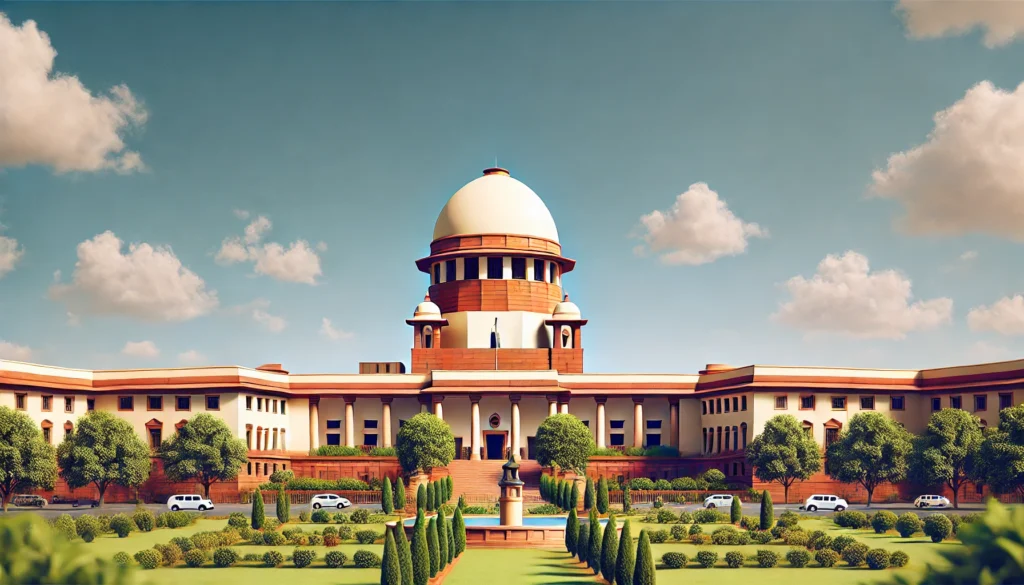
- Court: Supreme Court of India
- Bench: Constitution Bench (5 Judges)
- Date of Judgment: October 17, 2023
- Citation: (2023) SCC OnLine SC 1348
Abstract
This article analyses the Supreme Court of India’s landmark judgment in Supriyo v. Union of India (2023), which addressed the constitutional dimensions of marriage equality for same-sex couples in India. The Court’s split verdict, declining to recognize same-sex marriages while affirming the dignity of LGBTQ+ persons, marks a defining moment at the intersection of constitutional rights, judicial restraint, and legislative power. The article examines the competing constitutional arguments, the Court’s reasoning, and the broader implications for LGBTQ+ rights jurisprudence in India.
I. Introduction
The case of Supriyo v. Union of India (2023) represents a significant moment in India’s constitutional jurisprudence concerning LGBTQ+ rights and marriage equality.[1] While earlier landmark decisions such as Navtej Singh Johar v. Union of India (2018) decriminalized homosexuality, the question of legal recognition of same-sex marriages remained largely unresolved.[2] This case addressed whether the fundamental rights guaranteed under the Constitution extend to granting legal recognition to same-sex unions. The Supreme Court was confronted with complex constitutional questions involving equality, dignity, privacy, and the limits of judicial intervention. The judgment ultimately reflects a nuanced balance between progressive constitutional interpretation and judicial restraint.
II. Facts of the Case
The petitioners, consisting of several same-sex couples, approached the Supreme Court seeking legal recognition of their marriages under various laws, including the Special Marriage Act, 1954. They argued that the absence of legal recognition deprived them of numerous civil rights such as inheritance, adoption, insurance benefits, and medical decision-making. The petitioners contended that the denial of marriage equality violated their fundamental rights under Articles 14, 15, 19, and 21 of the Constitution of India.
The Union Government opposed the petitions, arguing that marriage is a socio-legal institution rooted in Indian culture and traditionally recognized only between a biological man and a woman. The government further argued that any change in this domain should be left to the legislature rather than the judiciary.
III. Issues Before the Court
1. Whether the Constitution guarantees a fundamental right to marry a person of one’s choice, including same-sex partners.
2. Whether the Special Marriage Act, 1954 can be interpreted in a gender-neutral manner to include same-sex marriages.
3. Whether denial of legal recognition to same-sex couples violates Articles 14, 15, 19, and 21 of the Constitution.
4. Whether the judiciary has the authority to recognize same-sex marriages or if it falls within the legislative domain.
IV. Arguments by the Petitioners
The petitioners advanced a rights-based argument grounded in constitutional morality. Their core contentions were as follows:
Right to Marry under Article 21: The right to marry a person of one’s choice is an intrinsic part of the right to life and personal liberty under Article 21 of the Constitution.[3]
Equality under Article 14: Excluding same-sex couples from the institution of marriage violates the principle of equality before law and equal protection of laws.[4]
Non-Discrimination under Article 15: Discrimination based on sexual orientation falls within the prohibited grounds of discrimination under Article 15 of the Constitution.[5]
Evolving Social Institution: Marriage is an evolving institution and must adapt to changing social realities and constitutional values.
The petitioners relied heavily on precedents such as Navtej Singh Johar v. Union of India and Justice K.S. Puttaswamy v. Union of India, both of which recognized privacy, dignity, and personal autonomy as fundamental rights.[6]
V. Arguments by the Respondent (Union of India)
The Union Government’s opposition rested on the following grounds:
Legislative Domain: Marriage is a matter of legislative policy and does not constitute a fundamental right that courts can enforce.[7]
Statutory Design: The Special Marriage Act, 1954 was specifically designed to govern heterosexual unions, and judicial reinterpretation would amount to legislating from the bench.
Cascading Consequences: Recognizing same-sex marriages judicially would require extensive amendments to personal laws and a wide range of other statutes, a task falling squarely within Parliament’s remit.
Judicial Restraint: Courts should exercise restraint and defer to Parliament on socio-cultural matters of such significance. The State also emphasized the institutional limitations of the judiciary in restructuring social institutions.
VI. Judgment of the Court
The Supreme Court, in a split verdict, declined to grant legal recognition to same-sex marriages. The majority held that the Constitution does not recognize a fundamental right to marry.[8] The Special Marriage Act, 1954 cannot be judicially reinterpreted to include same-sex couples, as doing so would amount to rewriting the statute rather than interpreting it.[9]
The Court further held that the recognition of same-sex marriages falls within the exclusive domain of the legislature. Importantly, however, the Court affirmed that LGBTQ+ persons possess the right to form relationships and live with dignity,[10] and directed the Union Government to constitute a committee to examine the grant of certain legal protections to same-sex couples, including rights relating to joint bank accounts, insurance nominations, and hospital visitation.
VII. Ratio Decidendi
The ratio of the majority judgment is twofold. First, the Constitution does not explicitly recognize a fundamental right to marry, and therefore courts cannot extend statutory marriage rights to same-sex couples without legislative action. Second, the doctrine of separation of powers places the task of restructuring social institutions of this nature firmly within the legislative domain. The Court, while acknowledging the dignity claims of LGBTQ+ persons, declined to exercise transformative judicial power in the absence of a clear constitutional mandate.
VIII. Critical Analysis
The judgment reflects both meaningful progress and significant limitations in India’s constitutional approach to LGBTQ+ rights. On the positive side, the Court’s reaffirmation of dignity, autonomy, and the right to form relationships builds upon the foundational principles established in Navtej Singh Johar and Puttaswamy. These affirmations are not merely rhetorical; they lay the groundwork for incremental legal protections that Parliament may codify in the future.
However, the refusal to recognise marriage equality reveals a continuing gap between the formal recognition of rights and their substantive realisation. The Court’s reliance on the separation of powers and legislative supremacy has drawn criticism from constitutional scholars who argue that this represents judicial restraint at the cost of substantive equality. When a marginalised group faces structural exclusion from a legal institution, the argument runs, it is precisely the judiciary’s role under a transformative Constitution to provide the corrective.
The majority’s finding that there is no fundamental right to marry is itself analytically contentious. Given that the Court in Puttaswamy read the right to choose one’s partner as an aspect of personal liberty under Article 21, the logical extension to the right to formalise that partnership through marriage was not unreasonable. The majority’s reluctance to take that step suggests a concern about the perceived institutional legitimacy of such a ruling rather than a purely textual constitutional conclusion.
Ultimately, Supriyo illustrates the tension between judicial activism and restraint in Indian constitutional law. The judgment leaves the realisation of marriage equality dependent on political will, which, given current legislative dynamics, may not be forthcoming in the near term. The case thus stands as an important marker of how far India’s constitutional courts are willing to go in protecting minority rights against majoritarian norms.
IX. Conclusion
Supriyo v. Union of India represents a critical juncture in India’s constitutional journey toward substantive equality. The Supreme Court’s split verdict, while affirming the dignity and relational autonomy of LGBTQ+ persons, declined to extend the full protection of marriage rights to same-sex couples, placing that responsibility on Parliament. Whether Parliament will act on this implicit invitation remains uncertain. What is clear, however, is that the constitutional conversation around marriage equality in India has been permanently altered by this judgment. The case will continue to be a touchstone for future litigation, legislative advocacy, and academic scholarship on the intersection of equality, dignity, and institutional power in Indian constitutional law.
References
[1] Supriyo v. Union of India, (2023) SCC OnLine SC 1348 (India).
[2] Navtej Singh Johar v. Union of India, (2018) 10 SCC 1 (India).
[3] Constitution of India, art. 21.
[4] Constitution of India, art. 14.
[5] Constitution of India, art. 15.
[6] Justice K.S. Puttaswamy v. Union of India, (2017) 10 SCC 1 (India).
[7] Supriyo v. Union of India, (2023) SCC OnLine SC 1348, Majority Opinion (India).
[8] Ibid.
[9] Ibid.
[10] Ibid.