Published On: October 15, 2026
Authored By: Madhvi Madaan
National Law University, Sonipat
Introduction and Background
In the rapidly expanding urban landscapes of contemporary India, public infrastructure development has historically prioritised motor vehicle mobility over pedestrian accessibility. However, a major judicial evolution has emerged across Indian constitutional jurisprudence: the recognition that pedestrian safety and unhindered access to footpaths are not merely matters of municipal administration or civic urban planning, but intrinsic components of fundamental constitutional guarantees. Footpaths in metropolitan areas face persistent structural degradation caused by illegal commercial encroachments, unauthorised vehicle parking, hawking activities, and hazardous municipal construction. When footpaths are blocked or rendered unsafe, pedestrians, including senior citizens, children, and persons with disabilities (Divyangjan), are forced to walk on active roadways, directly exposing them to traffic hazards and fatal road accidents.
This article critically examines the legal development surrounding the “Right to Walk” as a fundamental right derived from Article 21 (Right to Life and Personal Liberty) and Article 14 (Equality before Law) of the Constitution of India. It addresses the constitutional tension between pedestrian safety and the fundamental right to trade under Article 19(1)(g), evaluates recent judicial directives, and analyses the statutory duty of municipal corporations to maintain barrier-free public spaces.
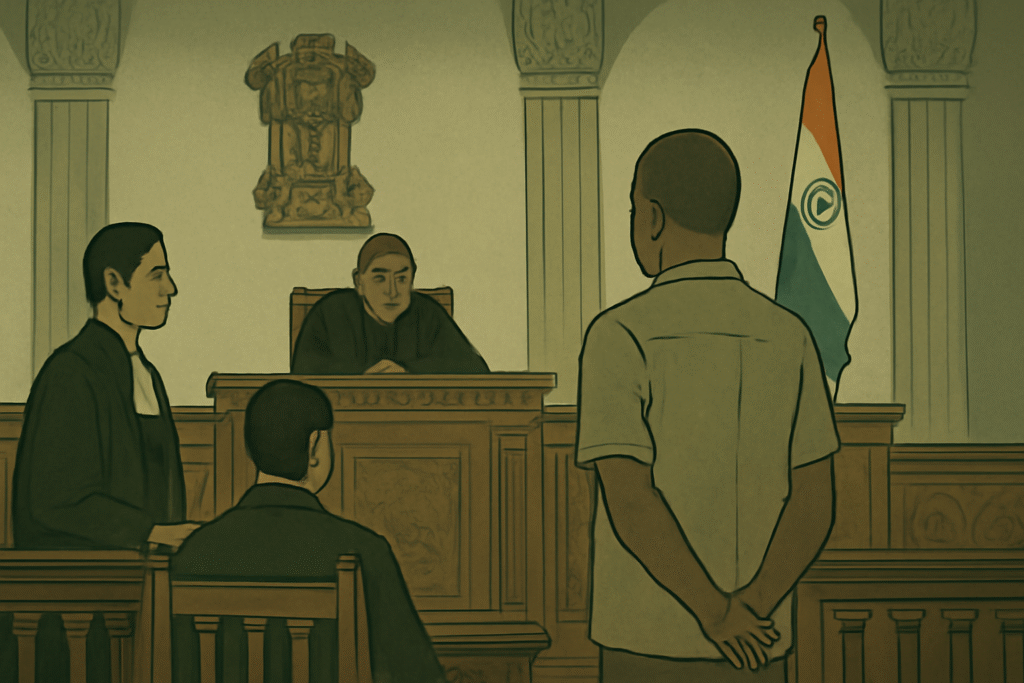
Departing from the traditional rules of tort liability under the Motor Vehicles Act, 1988, the Supreme Court of India in Maniyar Iliyaz @ Shaik Riyaz & Anr. v. P. Ayyappan & Ors.[1] elevated a routine road accident compensation claim into a constitutional question. The case originates from a personal tragedy that highlights the systemic vulnerabilities embedded within Indian urban design. The appellant was walking with his five-year-old son to a neighbourhood primary school when, owing to the complete absence of a designated pedestrian footpath or safe crossing, they were forced to walk along the active, motorised carriageway. A water tanker travelling from behind struck the young boy, causing fatal crush injuries.
Legal Analysis
2.1 Constitutional Foundation: Expanding Article 21 to Include Pedestrian Safety
Article 21 of the Constitution mandates that “No person shall be deprived of his life or personal liberty except according to procedure established by law.”[2] Over decades of activist jurisprudence, the Supreme Court of India has established that the “Right to Life” extends beyond mere animal existence to include human dignity, health, physical safety, and a quality of life free from avoidable environmental and physical hazards.
A walkable footpath is a direct prerequisite for the physical protection of citizens. Forcing pedestrians off pavements onto high-speed vehicular roads violates their fundamental right to personal security and physical integrity. Just as the judiciary has read the right to clean air, clean water, and safe working conditions into Article 21, the right to safe, unencroached, and accessible walking infrastructure is a logical extension of personal liberty and safe movement.
Furthermore, under Article 14,[3] urban planning that disproportionately allocates public spaces and municipal budgets to private vehicular traffic while failing to construct and maintain basic pedestrian infrastructure constitutes discriminatory policy design. Non-motorised transport (NMT) users represent a significant portion of urban commuters; ignoring their basic safety in favour of automobiles creates an inequitable urban hierarchy that violates the doctrine of equal protection.
2.2 The Constitutional Conflict: Article 21 vs. Article 19(1)(g)
The legal debate surrounding footpath clearance often triggers a complex constitutional clash between two competing fundamental rights:
1. The Pedestrian’s Right to Life and Safe Passage (Article 21).
2. The Street Vendor’s Right to Livelihood and Trade (Article 19(1)(g)).
In India’s informal economy, millions of street vendors, hawkers, and micro-traders rely on urban footpaths for their daily economic survival. Under Article 19(1)(g), all citizens have the right to practise any profession or to carry on any occupation, trade, or business.[4] The Supreme Court has repeatedly held that the right to livelihood is an integral facet of Article 21 itself.
However, the right to trade under Article 19(1)(g) is not absolute; it is subject to “reasonable restrictions” under Article 19(6) in the interests of the general public. While the state must protect informal livelihoods, no commercial activity can be permitted to completely extinguish the fundamental safety and free movement of the general public. Where a street vendor’s occupation leads to total physical blockage of footpaths, forcing pedestrians into hazardous traffic, the right to life (Article 21) must legally override or limit the exercise of business activities under Article 19(1)(g).
2.3 Vulnerable Road Users and the Accessibility Mandate
The degradation of pedestrian infrastructure has a disproportionate impact on Vulnerable Road Users (VRUs), a class encompassing pedestrians, senior citizens, children, and particularly persons with disabilities (Divyangjan). While an able-bodied individual might navigate around an illegal shop extension or step into active traffic to bypass a missing footpath slab, such obstructions present impassable physical barriers or life-threatening hazards for vulnerable populations.
From a constitutional perspective, the failure of state and municipal authorities to maintain accessible, barrier-free footpaths constitutes a dual violation of Article 19(1)(d) (Freedom of Movement) and Article 21 (Right to Life with Dignity). For a visually impaired or mobility-challenged citizen, an encroached or broken footpath does not merely cause inconvenience; it effectively forces involuntary confinement, stripping them of their fundamental liberty to navigate public spaces independently and safely.
Statutorily, this obligation is codified under Sections 40 and 41 of the Rights of Persons with Disabilities (RPwD) Act, 2016,[5] which mandate that local authorities provide barrier-free access to public roads, transportation, and pedestrian pathways. These provisions are supplemented by India’s international commitments under Article 9 of the UN Convention on the Rights of Persons with Disabilities (UNCRPD),[6] which binds state parties to eliminate structural obstacles in urban outdoor environments. Consequently, providing safe and accessible footpaths is not a discretionary municipal service; it is a mandatory statutory duty designed to enforce substantive equality under Article 14.
Supporting Authority
3.1 Judicial Precedents
The theoretical foundation for balancing pavement usage was laid in the landmark Supreme Court decision in Olga Tellis v. Bombay Municipal Corporation,[7] where the Court recognised that pavement dwellers and vendors derive their right to livelihood from Article 21. However, the Court explicitly noted that pavements are primarily intended for public passage and that municipal authorities possess statutory powers to remove encroachments to ensure public safety and hygiene.
In Sodhan Singh v. New Delhi Municipal Committee,[8] the Supreme Court clarified that while street vendors have a fundamental right to carry on trade on pavements, this right is strictly subject to proper regulation. The Court emphasised that no individual can claim a permanent right to occupy a specific spot on a public pavement if it hinders the passage of pedestrians.
More recently, Indian High Courts have taken proactive suo motu cognisance of pedestrian safety:
Bombay High Court (Suo Motu Writ Petition on Footpaths, 2023–2024): The Court issued stringent directives to the Brihanmumbai Municipal Corporation (BMC) and state authorities to clear unauthorised hawkers and illegal obstructions from footpaths, observing that clean and walkable footpaths are essential for senior citizens and disabled persons under Article 21.[9]
Punjab & Haryana High Court (Right to Walk Directives): The High Court held that municipal authorities have a statutory duty to provide safe, non-motorised transport tracks and footpaths, recognising pedestrian safety as a core obligation of state agencies.[10]
3.2 Statutory Frameworks
The judicial mandate for clear footpaths operates alongside key statutory instruments:
The Street Vendors (Protection of Livelihood and Regulation of Street Vending) Act, 2014:[11] This enactment was designed to harmonise the conflict between vending rights and public passage. The Act mandates Town Vending Committees (TVCs) to conduct surveys and designate specific “Vending Zones” and “Non-Vending Zones.” Under the Act, footpaths in high-density areas can be lawfully classified as Non-Vending Zones to guarantee unhindered pedestrian movement.
The Rights of Persons with Disabilities Act, 2016 (Sections 40 & 41):[12] Mandates that the Central and State Governments must ensure accessible, barrier-free public infrastructure, including roads and footpaths, for persons with disabilities.
The Motor Vehicles Act, 1988 (Section 138):[13] Empowers state governments to frame rules prohibiting the driving or parking of motor vehicles on footpaths and pedestrian walkways.
Conclusion
The recognition of the “Right to Walk” on clean, unencroached footpaths marks a critical paradigm shift in Indian constitutional law. Safe footpaths are not a luxury or a secondary urban preference; they are an essential constitutional requirement rooted in Articles 14, 19, and 21.
Moving forward, municipal corporations must transition from reactive encroachment drives to structural urban management. Achieving a constitutional balance requires:
1. Strict Implementation of the Street Vendors Act, 2014: Municipal bodies must immediately delineate clear Vending and Non-Vending Zones so that street hawkers are relocated to designated spaces without compromising primary pedestrian corridors.
2. Municipal Accountability: Urban local bodies must be held legally accountable under public law and tort liability for accidents and injuries caused by missing footpath slabs, open manholes, or municipal negligence.
3. Statutory Pedestrian Policies: State legislatures should enact comprehensive “Right to Walk” legislation that mandates a minimum percentage of road construction budgets be dedicated exclusively to non-motorised transport and pedestrian safety.
Reclaiming public footpaths is fundamentally about restoring dignity, equality, and safety to every citizen’s daily life.
References
[1] Maniyar Iliyaz @ Shaik Riyaz & Anr. v. P. Ayyappan & Ors., [2026] INSC 647 (India).
[2] India Const. art. 21.
[3] India Const. art. 14.
[4] India Const. art. 19(1)(g), 19(6).
[5] Rights of Persons with Disabilities Act, 2016, No. 49 of 2016, §§ 40–41 (India).
[6] Convention on the Rights of Persons with Disabilities art. 9, Dec. 13, 2006, 2515 U.N.T.S. 3.
[7] Olga Tellis v. Bombay Municipal Corporation, (1985) 3 SCC 545 (India).
[8] Sodhan Singh v. New Delhi Municipal Committee, (1989) 4 SCC 155 (India).
[9] Bombay High Court, Suo Motu Writ Petition on Footpaths (2023–2024) (India).
[10] Punjab & Haryana High Court, Right to Walk Directives (India).
[11] Street Vendors (Protection of Livelihood and Regulation of Street Vending) Act, 2014, No. 7 of 2014 (India).
[12] Rights of Persons with Disabilities Act, 2016, No. 49 of 2016, §§ 40–41 (India).
[13] Motor Vehicles Act, 1988, No. 59 of 1988, § 138 (India).