Published On: November 30th 2025
Authored By: Srishti Sinha
School of Law, University of Mumbai, Thane sub-campus
- Case Title: Kesavananda Bharati Sripadagalvaru v. State of Kerala & Anr.
- Citation: AIR 1973 SC 1461; (1973) 4 SCC 225
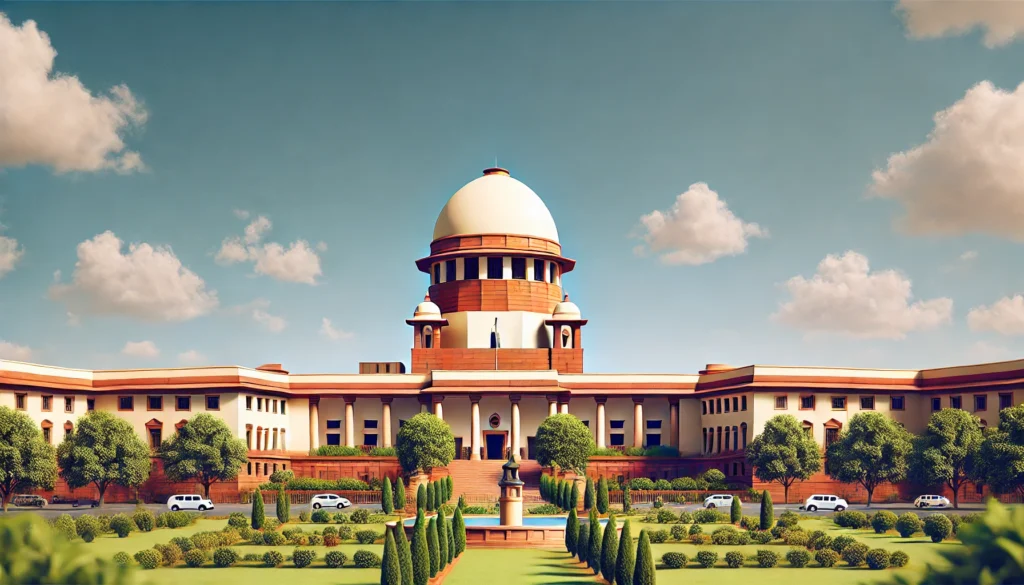
- Court: Supreme Court of India
- Bench: Largest constitutional bench ever in India consisting of 13 Judges: S.M. Sikri (CJI), J.M. Shelat, K.S. Hegde, A.N. Grover, A.N. Ray, D.G. Palekar, H.R. Khanna, M.H. Beg, Y.V. Chandrachud, K.K. Mathew, P. Jaganmohan Reddy, S.N. Dwivedi, and A.K. Mukherjea, JJ.
- Date of Judgment: 24 April 1973
- Key Provisions:
The relevant statutes involved in this case are as follows:
- Article 13 – Laws inconsistent with Fundamental Rights.
- Article 21 – Protection of life and personal liberty.
- Article 25 & 26 – Freedom of religion and rights of religious denominations.
- Article 368 – Power of Parliament to amend the Constitution.
- 24th, 25th, and 29th Constitutional Amendments – Central to the dispute.
Brief Facts
The case began with a rather personal concern but ended up reshaping the entire Indian constitutional order. Kesavananda Bharati, the head (seer) of the Edneer Mutt, a religious institution in Kerala, challenged the Kerala Land Reforms Act, 1963. The Act placed ceilings on landholdings and restricted property rights of institutions like his Mutt. He felt this law infringed his fundamental rights under Article 26 (right to manage religious property). However, by the time his petition reached the Supreme Court, the legal battle was no longer just about land. The core question had become much bigger: Can Parliament amend the Constitution in a way that takes away or even destroys Fundamental Rights? This was not the first time the question arose. Earlier, in Shankari Prasad (1951) and Sajjan Singh (1965), the Court had said Parliament’s amending power was unlimited. But in Golaknath (1967), the Court held that Parliament cannot amend Fundamental Rights. To reverse that ruling, Parliament passed the 24th, 25th, and 29th Amendments, expanding its own power. These amendments were now under direct challenge in Kesavananda Bharati. Thus, what started as a dispute over land ceilings became the longest and most significant constitutional case in India’s history.
Issues Involved
The Supreme Court was asked to settle profound constitutional questions:
Does Parliament have unlimited power under Article 368 to amend the Constitution?
- Can Parliament amend Fundamental Rights, including the core guarantees of equality, liberty, and freedom of religion?
- Are there inherent limitations on Parliament’s power, even if the text of Article 368 seems wide?
- Do the 24th, 25th, and 29th Amendments go beyond the permissible scope of constitutional amendment?
Arguments
Petitioner’s Contentions
The counsel appearing for Kesavananda Bharati, led by the legendary Nani Palkhivala, argued that the amending power of Parliament under Article 368 could not be read in absolute and unlimited terms. They contended that Parliament, being a creature of the Constitution, could not assume for itself the authority to destroy or fundamentally alter the very framework of the Constitution that gave it life. The Constitution, they emphasized, was not merely a collection of articles that could be changed at will, but rather a carefully crafted document with certain essential principles woven into its very fabric. They argued that the Fundamental Rights guaranteed under Part III were not gifts from Parliament that could be withdrawn at convenience. Instead, they were inalienable rights forming the core of Indian democracy. If Parliament were allowed to take away or dilute these rights through amendments, it would effectively make the Constitution meaningless for the ordinary citizen. They also pointed out that the doctrine of implied limitations must operate on Parliament’s amending power, meaning that even though Article 368 grants power to amend, it cannot be interpreted to permit destruction of the Constitution’s essential character. The petitioners further argued against the validity of the 24th and 25th Amendments. The 24th Amendment had expressly declared that Parliament could amend “any provision” of the Constitution, including Fundamental Rights, and the 25th Amendment limited the power of courts to review laws passed for implementing Directive Principles. According to the petitioners, these amendments struck at the very heart of judicial review and the delicate balance between individual rights and State power. They warned that if Parliament’s view prevailed, it could one day abolish democracy, fundamental freedoms, or even the Constitution itself, an outcome wholly inconsistent with the vision of the framers. Thus, Kesavananda’s side sought to protect the Constitution from being reduced to a mere political document, vulnerable to the whims of shifting parliamentary majorities. They pressed the Court to hold that while amendments were permissible, Parliament’s power stopped short at altering the essential features of the Constitution.
Respondents’ Contentions
On the other side, the State of Kerala and the Union of India, represented by the Attorney General, defended Parliament’s supremacy in the matter of constitutional amendments. They argued that Article 368, by its very wording, granted Parliament the widest possible power to amend the Constitution. In their view, an amendment was qualitatively different from ordinary law-making, it was an exercise of constituent power, not legislative power. Therefore, any attempt to limit Parliament’s amending power would amount to rewriting the Constitution by judicial interpretation, something the Court was never intended to do. The respondents contended that the framers of the Constitution deliberately refrained from putting any express limitation on Article 368. If they had intended to carve out areas of the Constitution as unamendable, they would have said so explicitly. By reading in implied restrictions, the petitioners were in effect inviting the Court to create limitations where none existed. Such judicial overreach, they warned, would undermine parliamentary democracy and place the unelected judiciary above the will of the people’s representatives. The State also defended the specific constitutional amendments under challenge. They argued that the 24th Amendment merely clarified Parliament’s existing power and ensured smooth governance after the Golaknath decision had created uncertainty. The 25th Amendment, they maintained, was necessary to promote Directive Principles of State Policy, particularly those relating to redistribution of wealth and social justice. They insisted that property rights could not be elevated above the collective good of society. Land reform laws like those in Kerala were designed to reduce inequality and bring about agrarian justice, objectives that the Constitution itself prioritised. In short, the respondents’ case rested on the principle of flexibility. They argued that a Constitution must be capable of growth and adaptation, and that this growth was entrusted to Parliament, which best represented the voice of the people. To hold otherwise, they claimed, would be to freeze the Constitution in time and obstruct India’s democratic progress.
Judgment
The judgment in Kesavananda Bharati v. State of Kerala was historic not only for its content but also for the way it was delivered. It was the longest hearing in the history of the Supreme Court at that time, lasting 68 days spread over several months. Thirteen judges of the Supreme Court sat together, which was unprecedented and remains the largest bench ever constituted in India. This fact alone reflected how important the questions before the Court were. On 24 April 1973, the judgment was finally pronounced. But instead of a clear and single opinion, what emerged was a deeply divided Court. Out of the 13 judges, seven held that Parliament’s power to amend the Constitution is not unlimited, while six judges held that Parliament has unrestricted authority under Article 368. Thus, by a razor-thin majority of 7:6, the Court laid down the doctrine that would forever change Indian constitutional law. The majority opinion, delivered through separate but converging judgments, held that Parliament does have very wide powers to amend the Constitution, including the Fundamental Rights chapter, but such power does not extend to altering or destroying the “basic structure” of the Constitution. This meant that while Parliament could introduce changes to adapt the Constitution to new challenges, it could not rewrite the entire document in a way that would take away its fundamental identity. Each judge in the majority expressed the doctrine in slightly different terms. Chief Justice Sikri, speaking on behalf of himself and several other judges, explained that certain features such as the supremacy of the Constitution, republican and democratic form of government, secular character of the State, separation of powers, and federalism were so essential that they could not be touched even by way of amendment. Justice H.R. Khanna, whose single vote became the deciding factor, observed that while Parliament’s power to amend was indeed vast, it did not include the power to destroy. His words became immortal: “The power to amend is not the power to destroy.” On the other hand, the six judges in the minority, including Justice A.N. Ray, who later became Chief Justice, took a more expansive view of Parliament’s powers. They held that Article 368 conferred plenary authority on Parliament to amend any part of the Constitution, and that the Court had no business imposing implied restrictions on that authority. They warned that creating a concept like “basic structure” would only lead to uncertainty, as no one could clearly define which features were basic and which were not. The Court then proceeded to apply this principle to the specific amendments under challenge. The 24th Amendment, which explicitly affirmed Parliament’s power to amend any part of the Constitution, was upheld as valid. However, the Court clarified that such power was subject to the newly articulated limitation, that it could not be used to destroy the basic structure. The 25th Amendment, which curtailed judicial review in matters relating to Directive Principles, was partly upheld, but its provision that completely excluded judicial scrutiny was struck down. The 29th Amendment, which placed certain Kerala land reform laws in the Ninth Schedule, was upheld, but again with the rider that laws inserted into the Ninth Schedule would still be open to challenge if they violated the basic structure. The judgment was not just long in hearing but also in writing. The thirteen judges delivered eleven separate opinions running into more than 700 pages. This diversity of reasoning made it difficult to immediately discern a single majority opinion, but the one common thread was the recognition, at least among seven judges, that the Constitution had certain untouchable fundamentals. In effect, while the petitioner, Kesavananda Bharati, lost his battle to save the land of his Mutt, the case gave India a new doctrine that has since served as a bulwark against authoritarianism: the Basic Structure Doctrine. The judgment struck a delicate balance. It did not deny Parliament the power to amend, but it placed a permanent check on that power by making sure that the essential values of the Constitution could not be taken away by transient political majorities. This case therefore marked the triumph of constitutionalism over absolute parliamentary sovereignty, shaping the destiny of Indian democracy for decades to come.
Ratio Decidendi
The ratio of the case is that:
Article 368 does not give Parliament unlimited power.
The Constitution has certain fundamental features, democracy, rule of law, judicial review, separation of powers, secularism, and fundamental rights, which form its basic structure.
Parliament cannot amend the Constitution in a way that damages or destroys this basic structure.
Obiter Dicta
Some judges made broader observations:
The Constitution is not merely a political document but a living, organic framework designed to protect people against misuse of power.
- The role of the judiciary as the guardian of the Constitution was emphasized.
- Justice Khanna, whose single vote tipped the balance, observed that “the power to amend does not include the power to destroy.”
Final Decision
The Court upheld the 24th Amendment as valid.
The 25th Amendment was partly upheld but its clause excluding judicial review was struck down.
The 29th Amendment, placing Kerala’s land reform laws in the Ninth Schedule, was also upheld, but subject to the basic structure test.
In the end, Kesavananda Bharati did not get his land back, but the case gave India a priceless principle: the Basic Structure Doctrine, which continues to limit parliamentary power to this day.