Published on: 23rd December, 2025
Authored by: Anjali Sharma
Asian Law College
Abstract
Environmental and climate justice represent critical frameworks for ensuring equitable treatment in environmental policy-making and addressing the disproportionate impacts of climate change on marginalized communities. This article explores the conceptual foundations of environmental and climate justice, examines their scope and interrelation, and analyzes the role of climate change litigation in India. Through an examination of landmark judicial decisions and the evolution of Environmental Impact Assessment (EIA) procedures, this article demonstrates how Indian jurisprudence has progressively strengthened environmental protections while highlighting persistent challenges in achieving true environmental equity.
I. Introduction
Environmental justice strives to assert equitable treatment and involvement of all individuals regardless of their diverse cultures, races, income, ethnicity, or geographical location.[1] The concept of environmental justice centers on making mindful environment-related decisions for the benefit and welfare of humankind. It rejects the notion of providing selective benefits to certain segments of society while ignoring marginalized and economically weaker communities.[2]
Environmental justice operates on the principle of treating every individual equally when it comes to availing the advantages rendered by the government. It empowers the weaker sections of society to speak for their rights and advocate their stance. Furthermore, it addresses how people’s health is affected by shortcomings in environment-related policies, including respiratory diseases, increased cancer rates, and other illnesses.
Climate justice, while closely related to environmental justice, has its own distinct concerns, including the impacts of climate change on populations such as extreme weather events, rising sea levels, and agricultural disruptions. Climate justice caters to the needs of the population at large and aims to rectify the historical and systemic inequalities that ultimately lead to unwanted climatic vulnerabilities.[3]
The concept firmly stands upon a global perspective by highlighting the responsibilities of developed nations that contributed most to greenhouse gas emissions. It extensively seeks not only equality of treatment between nations but also across international borders at large.[4]
II. Scope of Environmental and Climate Justice
A. Environmental Justice Scope
Environmental justice primarily addresses the concern that there should be fair treatment of all people irrespective of their race, income, or location in the development and enforcement of policies and initiatives put forward by governmental authorities. It has the specific aim of preventing communities, especially low-income groups, from bearing the unjust burden of environmental hazards and pollution.[5]
Environmental justice further strengthens the policy and governance framework of society through implementation of distinctive environmental laws and precedents. Moreover, it monitors the impact of industrial projects on indigenous communities and facilitates access to environment-related information and participation in decision-making processes.[6]
B. Climate Justice Scope
Climate justice categorically focuses upon fair dissemination of the burdens and benefits of climate change across each stratum of society irrespective of rank or social status. It recognizes that the burden of climate change falls disproportionately upon those segments of society who have contributed the least toward its aggravation, thereby creating a situation of injustice and discrimination while providing advantages to privileged developed nations that actually contributed significantly to these hazardous circumstances.[7]
The ultimate goal of climate justice is to ensure equity in access to clean energy and climate-resilient infrastructure.[8]
C. Combined Framework
Climate justice is considered a component of environmental justice, dealing with large-scale and transboundary issues. Both concepts require legal reforms, inclusive policies, and strong judicial oversight to effectively address environmental and climatic challenges. Their convergence reflects the interconnected nature of environmental degradation and climate change impacts on vulnerable populations.
III. Climate Change Litigation in India
Climate change litigation refers to legal proceedings where appellants or petitioners file suits against public or private entities for grave violations of their legal and basic human rights.[9] This form of litigation emerged due to extensive loopholes in the legislative framework to preserve and protect the rights of people, especially the marginalized strata of society.
Climate change litigation has played an extensive and impactful role in influencing social norms and public debates. Several scholars have witnessed and documented the influence of this form of litigation upon longstanding social norms. For instance, climate litigation has contributed to the transformation of political culture and public debates to become more climate-centered and informed. It has supported and promoted grassroots-level climate-related campaigns and initiatives, making them accessible to people who may not be sufficiently literate to access them independently. Most importantly, it has facilitated the translation of scientific concepts into tangible impacts that the population can understand and grasp, enabling them to adapt in a constructive manner.[10]
Climate change litigation has been growing across jurisdictions and borders. Appeals before the courts have raised numerous questions regarding various interpretations of law concerning climate mitigation phenomena and adaptation procedures and measures. Contemporary claims related to climate change concern compliance with climate commitments, violations of human rights and constitutional rights of citizens, and corporate liabilities.[11]
In a developing nation like India, climate claims relate to the implementation of governmental policies and initiatives to adapt to the climate change crisis and regulate the livelihoods of the population.
A. Emerging Trends and Legal Strategies
1. International Environmental Law: The Supreme Court of India has strengthened the environmental legal framework of the country by incorporating principles such as the polluter pays principle, public trust doctrine, and precautionary principles. The establishment of the National Green Tribunal has been central to this jurisprudence, incorporating concepts of international environmental law into domestic jurisprudence.[12]
2. Public Interest Litigation (PIL): The Indian judiciary has an age-old tradition of allowing individuals and groups to file PILs to challenge grave environmental issues. A landmark example is M.C. Mehta v. Union of India (1987), which introduced the doctrine of absolute liability for industrial incidents affecting millions. This case, also known as the Oleum Gas Leak Case, serves as one of the most important landmark judgments in the judicial history of environmental law.[13]
3. Expansion of Locus Standi: The Indian judiciary has expanded the scope of locus standi (the right to bring a case to court) for individuals and groups to address and challenge environmental issues, thereby democratizing access to environmental justice.
4. Seeking Restorative Justice: Several cases seek restorative justice for aggrieved parties by ordering offenders or polluters to pay for harm caused, such as respiratory diseases caused by poisonous gases leaked from industries and factories.
IV. Role of the Judiciary
The Indian judiciary has played a transformative role in developing environmental jurisprudence through several landmark decisions:
A. M.C. Mehta v. Union of India (Oleum Gas Leak Case)
This case arose when oleum gas leaked from a factory in December 1985, causing significant damage to the environment and public health. The Supreme Court held that this case involved absolute liability, and no exceptions would apply as previously recognized in Rylands v. Fletcher (1868). This was a landmark judgment due to its introduction of the rule of absolute liability in Indian environmental law.[14][15]
B. Charan Lal Sahu v. Union of India (Bhopal Gas Tragedy Case)
In this case, the court established a crucial link between environmental quality and the Right to Life and Personal Liberty enshrined under Article 21 of the Constitution of India, expanding constitutional protections to encompass environmental rights.[16][17]
C. Subhash Kumar v. State of Bihar
The Supreme Court held that Article 21 (Right to Life and Personal Liberty) of the Indian Constitution includes not only the right to life but also the right to a healthy environment, including the right to pollution-free water and air for better enjoyment of life. The court recognized the right to a healthy environment as a fundamental right of every individual.[18][19]
D. Indian Council for Enviro-Legal Action v. Union of India (Enviro Action Case)
This case was filed for remedial action due to damage caused by chemical industries in Bichhri village, Udaipur district, Rajasthan. Although the industries were shut down, people continued to suffer from toxic effluents contaminating their soil and water. The Supreme Court of India applied the polluter pays principle and held that the responsibility of paying damages for the pollution lies with the undertaking causing the pollution.[20][21]
E. M.C. Mehta v. Kamal Nath (Kamal Nath Case)
This case involved a private company named Span Motel Pvt. Ltd. that was granted a lease by the Himachal Pradesh Government to set up a motel near the Beas River. The motel allegedly encroached into a forest, leading to environmental degradation. The Supreme Court held that the Public Trust Doctrine is an essential doctrine for protection of natural resources and ordered the private company to restore the forest land and pay the required damages.[22][23]
F. T.N. Godavarman Thirumulpad v. Union of India (Godavarman Case)
In this case, the Supreme Court of India liberally interpreted the Forest Conservation Act, 1980, and provided comprehensive safeguards to protect forest resources and biodiversity.[24][25]
V. Environmental Impact Assessment (EIA)
Environmental Impact Assessment is a process of evaluating the environmental impact of proposed projects or initiatives by the government.[26] Essentially, it is a tool to assess the socioeconomic, cultural, and human health-related impacts of a governmental project.[27]
A. Evolution of EIA
Environmental Impact Assessment originated in the United States in 1969 when the USA implemented its first National Environmental Policy Act (NEPA).[28] The Act was initially adopted by developed nations but later was introduced to developing nations like India. In 1989, the World Bank adopted the EIA as a requirement for major development projects and laid down various requirements and guidelines. In the 1990s, India formally adopted the EIA framework and focused upon extensive EIA training and implementation.
B. Objectives of EIA
EIA provides information on environmental consequences for the decision-making process in India. It promotes developments that are environmentally sound and suitable by recognizing appropriate options and mitigation measures.[29]
C. Procedure of EIA
The process of EIA consists of the following stages:[30]
1. Screening: This is the first stage where the need for EIA assessment is recognized, and if required, the level of assessment is determined.
2. Scoping: This stage determines the key issues and impacts that need to be investigated.
3. Impact Analysis: This stage analyzes the significance of environmental and social impacts of the proposed project.
4. Mitigation: This stage recommends measures to reduce and avoid potential adverse environmental consequences.
5. Reporting: This stage presents the evaluation report of the EIA to the decision-making body.
6. Review of EIA: This stage assesses the adequacy of the EIA report and ensures it provides the necessary information.
7. Decision Making: This stage confirms whether the proposed project is accepted, rejected, or needs reconsideration.
8. Post-Monitoring: This stage checks the conformity of the project’s impacts to legal standards after the project has been commissioned. It also verifies whether mitigation measures are implemented exactly as mentioned in the project’s EIA report.
D. Practice of EIA in India
EIA commenced in India in 1976-77 when the Planning Commission directed the Department of Science and Technology to assess river valley projects from an environmental perspective.[31]
In 1982, the Ministry of Environment, Forest and Climate Change established the Environmental Information System (ENVIS) to collect, store, and distribute information related to the environment sector. ENVIS was set up to manage environmental assessment activities in an efficient and effective manner.
In 1986, the Indian Government enacted several environmental laws and acts, including the Environment Protection Act, making the concept of EIA statutory. Similarly, other legislation such as the Indian Wildlife Protection Act (1972), the Water Act (1974), and the Biological Diversity Act (2002) strengthened the environmental regulatory framework.
VI. Challenges
Evolving Legal Framework: Due to the dynamic nature of Indian jurisprudence in terms of climate change litigation, there are emerging trends and legal strategies that the judiciary must continually adapt to and incorporate.
International Cooperation: For climate change to be adequately addressed, there is a dire need for both developed and developing nations to express global cooperation, which remains a daunting task in contemporary times given geopolitical complexities and competing national interests.
Complexity of Climate Change Issues: Due to the complex and often technical nature of climate change issues, careful consideration and specialized expertise are required for effective adjudication and policy implementation.
VII. Conclusion
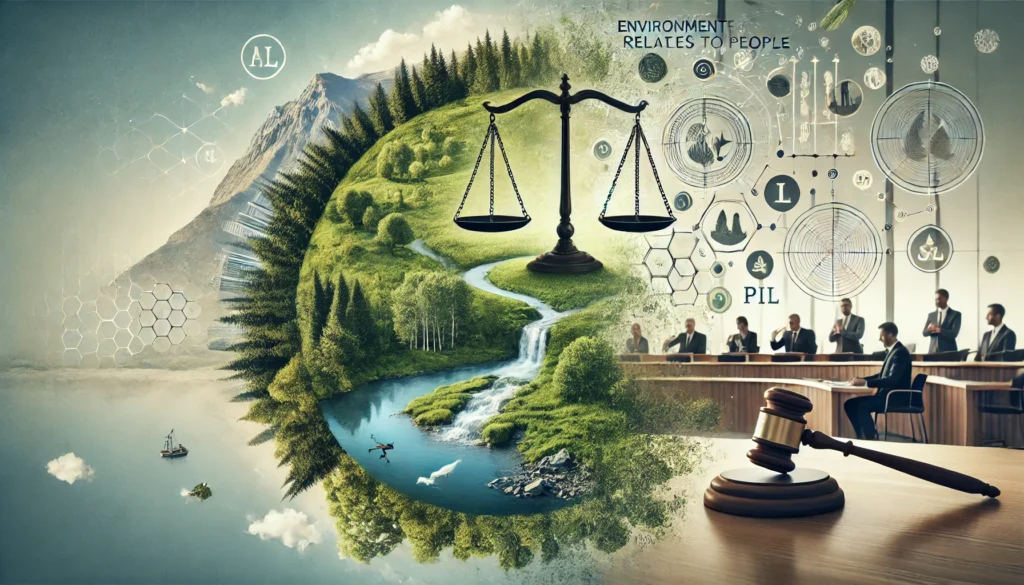
There exists a complex relationship between the environment and framed public policies. Through the formulation and implementation of various regulations and incentives, these policies strive to address environmental challenges and hazards.[32] Assessment procedures like EIA provide a route to establishing and maintaining a flourishing environmental sector with strong support from the judiciary.
The Indian judiciary has demonstrated remarkable commitment to environmental protection through progressive interpretation of constitutional provisions and the development of robust environmental principles. From the establishment of absolute liability in the Oleum Gas Leak Case to the recognition of environmental rights as fundamental rights under Article 21, Indian courts have consistently expanded the scope of environmental justice.
However, significant challenges remain. The complexity of climate change issues, the need for international cooperation, and the continuous evolution of legal frameworks require sustained attention from all stakeholders. Moving forward, the integration of environmental and climate justice principles into policy-making, coupled with strong judicial oversight and effective implementation of assessment mechanisms like EIA, will be crucial for ensuring equitable and sustainable development for all segments of society, particularly the most vulnerable and marginalized communities.
References
[1] Environmental and Climate Justice: A Public Policy Discourse, RESEARCHGATE (2024), https://www.researchgate.net/publication/381390165_Environmental_and_Climate_Justice_A_Public_Policy_Discourse.
[2] Id.
[3] Id.
[4] Id.
[5] Id.
[6] Id.
[7] Id.
[8] Id.
[9] Vidya Ann Jacob, Climate Litigation in India: An Overview, Winter Issue 2021.
[10] Id.
[11] Id.
[12] Id.
[13] M.C. Mehta v. Union of India, AIR 1987 SC 1086
[14] Id.
[15] Leaving a Better World: Role of Judiciary in Protecting Environment, HIGH COURT OF CHHATTISGARH, https://highcourt.cg.gov.in/artical/Role_Judiciary_Pro_Env.html.
[16] Charan Lal Sahu v. Union of India, AIR 1990 SC 1480
[17] Role of Indian Judiciary in Protection of the Environment, IPLEADERS BLOG, https://blog.ipleaders.in/role-of-indian-judiciary-in-protection-of-the-environment/.
[18] Subhash Kumar v. State of Bihar, AIR 1991 SC 420
[19] Role of Indian Judiciary in Protection of the Environment, supra note 17.
[20] Indian Council for Enviro-Legal Action v. Union of India, (1996) 3 SCC 212
[21] Leaving a Better World: Role of Judiciary in Protecting Environment, supra note 15.
[22] M.C. Mehta v. Kamal Nath, (1997) 1 SCC 388
[23] Leaving a Better World: Role of Judiciary in Protecting Environment, supra note 15.
[24] T.N. Godavarman Thirumulpad v. Union of India, (1997) 2 SCC 267
[25] Leaving a Better World: Role of Judiciary in Protecting Environment, supra note 15.
[26] Environmental Impact Assessment, BYJU’S, https://byjus.com/free-ias-prep/eia/.
[27] Id.
[28] Id.
[29] Id.
[30] Understanding EIA, CENTRE FOR SCIENCE AND ENVIRONMENT, https://www.cseindia.org/understanding-eia-383.
[31] Id.
[32] Environmental and Climate Justice: A Public Policy Discourse, supra note 1.