Published on: 24th December, 2025
Authored by: Christopher Benjamin Chukwuemeka
University of Lagos
Abstract
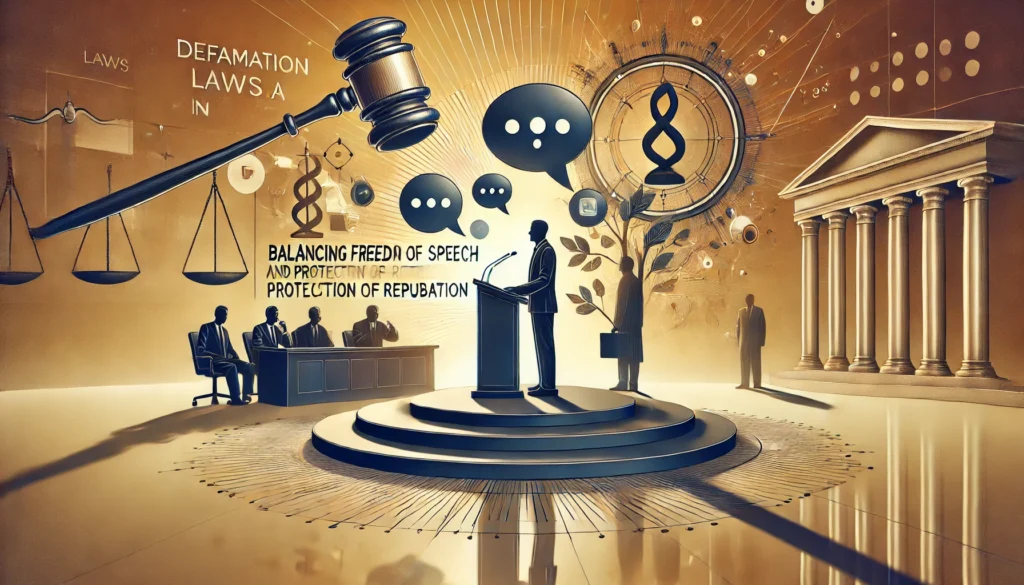
Freedom of expression is an important fundamental right, because the right to speak one’s mind freely on important issues in society, access information, and hold the government of the day accountable, plays a vital role in the healthy development process of any society. It is universally acknowledged that the right to freedom of expression is a foundational human right of great importance. At the same time, it is also recognized that it is not an absolute right, and every democracy has developed some system of limitations on freedom of expression.
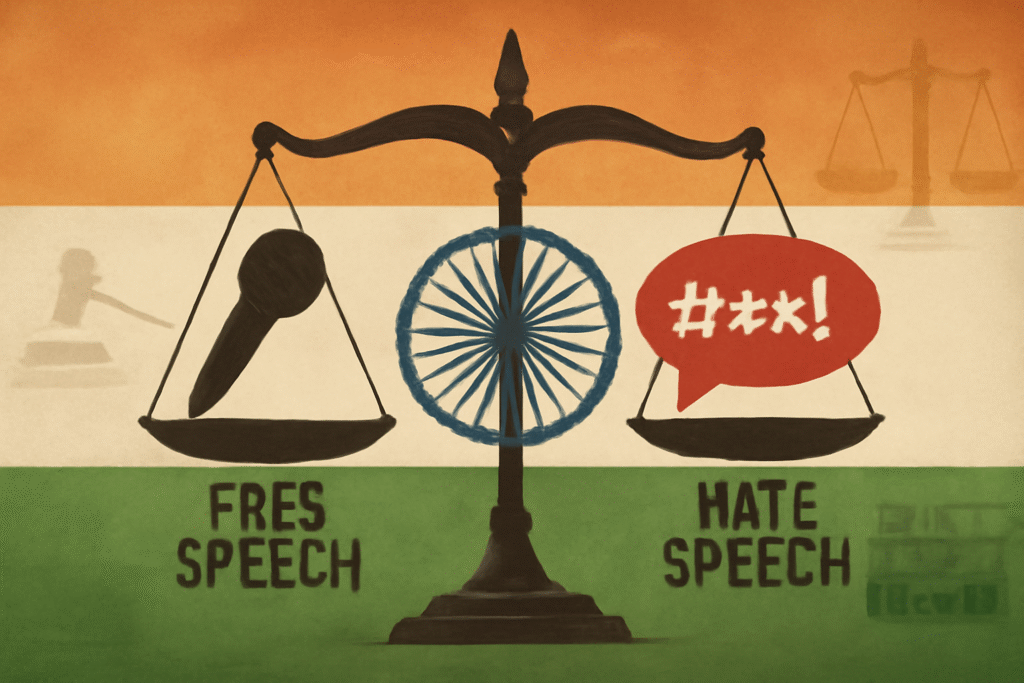
In democratic societies, freedom of speech is a cornerstone that upholds civil liberties, fosters public debate, and promotes the marketplace of ideas. However, when this freedom is weaponized to propagate hate, discrimination, or violence, the need arises to delineate its limits. In India, a pluralistic and culturally diverse society, maintaining a balance between freedom of speech and the regulation of hate speech presents unique legal and ethical challenges. This article explores the constitutional, legislative, and judicial dimensions of this tension, evaluating how Indian democracy grapples with protecting freedom of expression while curbing hate.
Introduction
Freedom of expression has always been a vital feature of any society. Expression in this context includes the right to hold views or opinions, speech, publish articles or books or leaflets, television or radio broadcasting, producing works of art, communication through the internet, some forms of commercial information and many other activities. Simply construed, the right to freedom of expression can be defined as the right to communicate or express one’s opinions.
Generally speaking, the right to freedom of expression extends to unpopular ideas and statements which “shock, offend or disturb”.[1] This may come in the form of hate speech or offensive remarks. Hate speech, which targets individuals or groups based on religion, caste, ethnicity, gender, or other identities, is a growing concern in India. With the rise of digital platforms and a charged political climate, the line between dissent and incitement has blurred, raising critical legal questions. There is therefore the need for the State to put in place regulations of free speech without infringing upon democratic freedoms.
Constitutional Framework for Freedom of Speech
The right to free speech is protected by both international and regional laws, thus emphasizing the importance of this freedom. According to Euripides, an ancient Greek poet, “A slave is he who cannot speak his thoughts“. Thus, in a democratic government, where governance is seen as a reflection of the people’s will, the right of the masses to form opinions, hold grievances, express their train of thoughts must be established, protected, and respected. John Stuart Mill, a foremost philosopher of free expression and influential advocate of free speech stated that there should be absolute freedom of opinion and sentiments on all subjects, practical or speculative, scientific, moral, political or theological, however immoral the opinion or sentiment may be.[2]
Article 19(2) of the Universal Declaration of Human Rights (UDHR)[3] provides for this right in the following words: “Everyone has the right to freedom of opinion and expression; this right includes freedom to hold opinions without interference and to seek, receive and impart information and ideas through any media and regardless of frontiers“.
Article 19 of the International Covenant on Civil and Political Rights (ICCPR),[4] provides for the right to freedom of expression in three umbrellas: (i) freedom to seek, (ii) freedom to receive, and (iii) freedom to impart information and ideas of all kinds irrespective of frontiers in any medium. The right to freedom of expression is an indispensable condition for the full development of the person, it is essential for the development of any society. It provides a vehicle for the promotion and protection of human rights. The right to freedom of expression is a necessary condition for the realization of the principles of transparency and accountability that are in turn essential for the promotion and protection of human rights.[5]
The right to freedom of speech is also protected domestically under the Constitution of India[6] Article 19. Subsection [1](a) guarantees all citizens the right to freedom of speech and expression. The framers of the Constitution considered it essential for individual development and democratic governance. It includes the right to express one’s opinion through words, writing, signs, or any other mode of communication. As aforementioned, this right is not absolute and each democracy implements its own restrictions to curtail abuse of this constitutionally guaranteed right. Article 19(2) allows the State to impose restrictions on the right to freedom of expression in the interest of: sovereignty and integrity of India, security of the State, friendly relations with foreign states, public order, decency or morality, contempt of court, defamation, incitement to an offence. The test of “reasonableness” is determined on a case-by-case basis, balancing the need for restriction against the importance of free speech in a democratic society.
Definition of Hate Speech: Concept and Challenges
There is no clear statutory and comprehensive legal definition of the concept of hate speech. Various laws address aspects of it, but none provide a cohesive standard. This ambiguity leads to selective enforcement and potential misuse. The philosopher Jeremy Waldron argues that, while purely offensive speech may not justify restrictions, there is a class of injury, amounting to more than hurt sentiments but to less than harm, in the sense of physical injury, that demands restriction in democratic frameworks;[7] hate speech falls within such class of injury. The Council of Europe[8] defines hate speech as: “Covering all forms of expression which spread, incite, promote or justify forms of hatred based on intolerance, including: intolerance expressed by aggressive nationalism and ethnocentrism, discrimination and hostility against minorities, migrants and people of immigrant origin“.
The 267th Report of the Law Commission (2017) recommended defining hate speech to include expressions that incite hatred against groups based on race, religion, caste, or sexual orientation. It proposed amendments to the Indian Penal Code[9] to introduce new provisions—Sections 153C and 505A—to penalize hate speech effectively.
Indian law contains several provisions that indirectly deal with hate speech. These provisions will be examined below:
Indian Penal Code, 1860
Section 124A: Punishes speech or expression that attempts to bring hatred or contempt towards the government.
Section 153A: Criminalizes promoting enmity between groups on grounds of religion, race, language, etc.
Section 295A: Punishes deliberate and malicious acts intended to outrage religious feelings.
Section 505(1) & (2): Addresses statements that cause public mischief or promote enmity.
Information Technology Act 2000[10]
Section 66A: Originally penalized offensive messages sent through communication service. In Shreya Singhal v. Union of India,[11] the Supreme Court, in a landmark judgment, struck down Section 66A of the Information Technology Act for being vague and violative of Article 19(1)(a). It differentiated between discussion, advocacy, and incitement; and held further that only incitement to violence could be restricted under Article 19(2), thus setting a high threshold for curbing speech.
Section 69A: Empowers the government to block online content in the interest of public order or national security.
Representation of the People Act 1951
Section 123(3A) & 125: Prohibits promotion of enmity in electoral campaigns based on religion, race, caste, community, or language.
In S. Rangarajan v. P. Jagjivan Ram,[12] the Court held that freedom of expression cannot be suppressed unless the situation created by it is dangerous to the community or public interest and involves incitement to violence. In Pravasi Bhalai Sangathan v. Union of India,[13] the petitioner, a welfare organization for inter-State migrants filed under Article 32 of the Constitution as a Public Interest Litigation raising concerns on increasing hate speech by political and religious leaders based on religion, caste, region, and ethnicity. The Court expressed concern over hate speech but refused to frame guidelines, stating that it is the legislature’s role. It encouraged self-regulation and suggested that existing laws, if properly enforced, could curb hate speech. In Amish Devgan v. Union of India,[14] the Court upheld FIRs against a TV anchor accused of hate speech, reaffirming that free speech does not include expressions that incite violence or disturb communal harmony.
Role of Media and Social Media
Mainstream media plays a pivotal role in shaping public opinion. However, sensationalist journalism, biased reporting, and incendiary panel discussions have sometimes served as platforms for hate speech, especially during election seasons or communal unrest. Digital media spreads messages beyond the intended audience and contexts with unpredictable results. Digital platforms like Facebook, X (formerly Twitter), and YouTube often amplify polarizing content. Online hate speech is considered a threat that creates violence and intolerance through digital media with its real effects: hate crimes, offline aggressions, religious discrimination, gender-based violence which affects the mental health of victims. Despite efforts by the government and social media platforms to stop all sorts of hate speech, they continue to affect our society.[15]
The lack of real-time moderation and anonymity contributes to the unchecked proliferation of hate speech. Efforts to regulate online speech, such as the Information Technology Rules 2021, have raised concerns of overreach. While aimed at controlling harmful content, these rules have been criticized for enabling governmental censorship and intimidating dissenting voices.
Comparative Jurisprudence: Lessons from Foreign Countries
United States
The First Amendment of the U.S. Constitution offers strong protection to free speech, including hate speech, unless it incites “imminent lawless action”. This high threshold limits governmental intervention.
In Brandenburg v. Ohio,[16] a Ku Klux Klan leader in Ohio, made a speech at a rally that included racist and violent rhetoric. He was convicted under Ohio’s Criminal Syndicalism Act, which prohibited advocating violence for political reform. The conviction was reversed on appeal to the Supreme Court, which declared Ohio’s law unconstitutional.
United Kingdom
The UK balances free expression with laws against hate speech, especially under the Public Order Act 1986[17] and the Racial and Religious Hatred Act 2006.[18] These criminalize threatening or abusive conduct intended to stir up hatred.
Germany
Owing to its history, Germany adopts a strict approach. The Criminal Code (§130) prohibits incitement to hatred and denial of the Holocaust. Freedom of expression is subordinate to democratic and human dignity values under the Basic Law.
India, in contrast must craft its own model that aligns with its socio-political context, diverse populace, and constitutional values.
Balancing Test: Principles and Recommendations
Restrictions must be narrowly tailored and proportionate to the harm sought to be prevented. Blanket bans or arbitrary actions can violate constitutional guarantees. There is also the need for legislative clarity. Parliament must enact a comprehensive law defining and penalizing hate speech with clarity. Ambiguities in current provisions (e.g., “deliberate and malicious intent”) must be addressed to prevent misuse. Furthermore, courts must strike a balance between individual liberty and social harmony, with consistent jurisprudence. Prior restraint must be minimized, and speech must be curbed only if it meets the incitement threshold.
Legal tools alone cannot eradicate hate speech. Public awareness, counter-speech, and digital literacy are crucial in addressing underlying prejudices. The Election Commission, Press Council, and media watchdogs must be empowered to act against hate speech by political actors or media houses.
Hate Speech by Political Actors: A Growing Threat
In recent years, political discourse has witnessed an increase in communal rhetoric. Leaders have often indulged in provocative speeches with impunity, knowing that legal consequences are minimal. In Abdul Nasar Madani v. State of Tamil Nadu,[19] the Supreme Court noted the need for political accountability. In the instant case, an application for transfer of trial from Tamil Nadu to Kerala over concerns of communal bias and fair trial was rejected by the Court. The petitioner, a political and religious leader was alleged to have been involved in the “Coimbatore bomb blast case“. Since a fair trial was possible in Tamil Nadu, the Supreme Court directed the trial to be conducted expeditiously and impartially.
The Model Code of Conduct and the Representation of the People Act must be more strictly enforced during election seasons. Parties should face electoral sanctions for repeated violations.
Conclusion
In India’s vibrant and tumultuous democracy, freedom of speech is both a sword and a shield. It must protect citizens against tyranny but not empower them to tyrannize others through hate. The challenge lies in creating legal and societal norms that draw a bright line between permissible dissent and impermissible vilification.
As jurisprudence evolves and technologies advance, the law must remain rooted in constitutional morality—respecting dignity, diversity, and dialogue. India must resist both the temptation of censorship and the poison of unchecked hatred. Only then can it preserve the democratic promise of liberty, equality, and fraternity for all.
References
[1] Handyside v. United Kingdom [1976] 1 EHRR 737.
[2] John Stuart Mill, “Essays on Human Liberty” in Walter Laquer and Barry Rubin (eds), The Human Rights Reader (New York, revised edition 1990) p. 87.
[3] GA Resolution 217A (III) December 10 [1948].
[4] GA Resolution 2200A (XXI) December 16 [1966].
[5] General Comment No. 34 on Article 19 of the International Covenant on Civil and Political Rights – Freedom of Expression and Opinion. 102nd session of the Human Rights Committee. Geneva 11-29 July 2011. CCPR/C/GC/34.
[6] Eightieth Amendment Act 2000.
[7] Jeremy Waldron, The Harm in Hate Speech (Harvard University Press: Cambridge, 2012) p. 87.
[8] Council of Europe Committee of Ministers Recommendation No. R (97) 20 on “Hate Speech” (Adopted by the Committee of Ministers on 30 October 1997 at the 607th meeting of the Ministers’ Deputies).
[9] No. 45 of 1860 [6th October, 1860].
[10] No. 21 of 2000.
[11] AIR 2015 SC 1523.
[12] [1989] SCR (2) 204.
[13] AIR 2014 SC 1591.
[14] AIR 2020 SC 930.
[15] Journal of Development and Social Sciences, Apr-June (2024), Vol 5, No. 2(S) [303-314].
[16] 395 U.S. 444 (1969).
[17] C. 64 Regulations 202(X).
[18] C. 1.
[19] AIR 2000 SC 2293.