Published on: 23rd December, 2023
Authored by: Apoorva Sharma
Department of Laws Panjab University Chandigarh
“Freedom of speech is not the freedom to cause harm. Words can inspire, uplift, and also destroy. The challenge for democracy is to draw the right line.” – Pranab Mukherjee, Former President of India.
Abstract
Freedom of speech and expression is considered one of the core pillars of any vibrant democratic system. India holds the position of the world’s largest democracy; freedom of speech and expression forms the bedrock and is an indispensable part of its constitutional structure. The Constitution of India, under Article 19(1)(a), gives its citizens a fundamental right to freely express their views, criticize the government, hold the authorities accountable, and engage meaningfully in public discourse. However, this basic right is not absolute; under Article 19(2) of the Indian Constitution, powers are given to the government to impose reasonable restrictions on the grounds of public order, decency, morality, defamation, etc., especially to curb hate speech, which has been a matter of debate. Hate speech, in layman’s terms, refers to a speech that can incite hatred, violence, or discrimination against any individual or a particular group, especially in a diverse country like India. Hence, striking the right balance between free speech and restricting hate speech is essential to keep the Indian democracy robust and maintain a harmonious society.
This article examines the intricate legal framework governing the constitutional balance between protecting free speech and regulating hate speech in India. It examines the key statutory provisions and judicial pronouncements, highlighting the emerging role of the state in regulating speech through landmark decisions. The reasons for the absence of a definition of hate speech in Indian laws are also explored, as well as the impact of digital platforms on the regulation of speech.
Keywords: hate speech, regulation, freedom, speech, expression, Constitution.
Introduction
Article 19(1)(a) of the Indian Constitution provides the right to freedom of speech and expression. It states that “all citizens shall have the right to freedom of speech and expression.”[1]
This right is available to the citizens of India, excluding non-citizens to enjoy this as a fundamental right. Freedom of speech and expression allows every citizen to freely express opinions on government and society, disseminate information via publication and media, have the right to dissent and criticize public authorities about the policies that go against the interests of the citizen, as we have at the time of the farmer’s protest and anti-CAA protests, and be exposed to ideas through any medium like Twitter, Instagram, etc. This right includes diverse modes of communication, such as through writing, gestures, speech, visual representation, etc. Freedom of speech and expression is not absolute but is qualified in nature. For instance, an individual has the right to speak freely but cannot spread hate through his speech. Article 19(2) of the Constitution of India empowers the state to impose reasonable restrictions. However, to prevent the state from exceeding its power, so that it does not curtail individual’s freedom of speech. The restrictions imposed must be ‘reasonable,’ which means they should be backed by law, constitutionally justified, and not excessive. It must follow the doctrine of proportionality. According to this doctrine, if any action is taken by the government to curtail an individual’s fundamental right, then the restriction should not be too extreme or harsh. It needs to be fair, vital, and comprehensive. It ensures that the restriction or punishment does not outweigh the issue that it is trying to solve. If someone is spreading hate speech that hurts religious sentiments via a digital platform, then the government can curtail his freedom of speech, but banning the entire internet is out of proportion.
Reasonable restriction under Article 19(2)[2] of the Indian Constitution—
“Nothing in sub-clause (a) of clause (1) shall affect the operation of any existing law, or prevent the state from making any law, in so far as such law imposes reasonable restrictions on the exercise of the right conferred by the said sub-clause in the interest of,[3] [the sovereignty and integrity of India,] the security of the state, friendly relations with foreign States, public order, decency or morality, or in relation to contempt of court, defamation or incitement to an offence.”
These restrictions are meant to achieve a balance between protecting individual’s rights and maintaining public order, national integrity, and the safety of others. One of the earliest judgments on free speech is the landmark case of Romesh Thappar v. State of Madras.[4] The Supreme Court emphasized that freedom of speech is essential in a democracy. The restrictions should be imposed only on the grounds mentioned in Article 19(2). This early judgment formed the basis for understanding how far the government can go in limiting speech. The state cannot arbitrarily or vaguely limit freedom of speech. Later, courts repeatedly clarified that the restriction on speech must be reasonable and constitutionally valid and should not be misused to silence criticism or dissent. After this case, “public order” became a valid ground under Article 19(2) to restrict freedom of speech and expression.
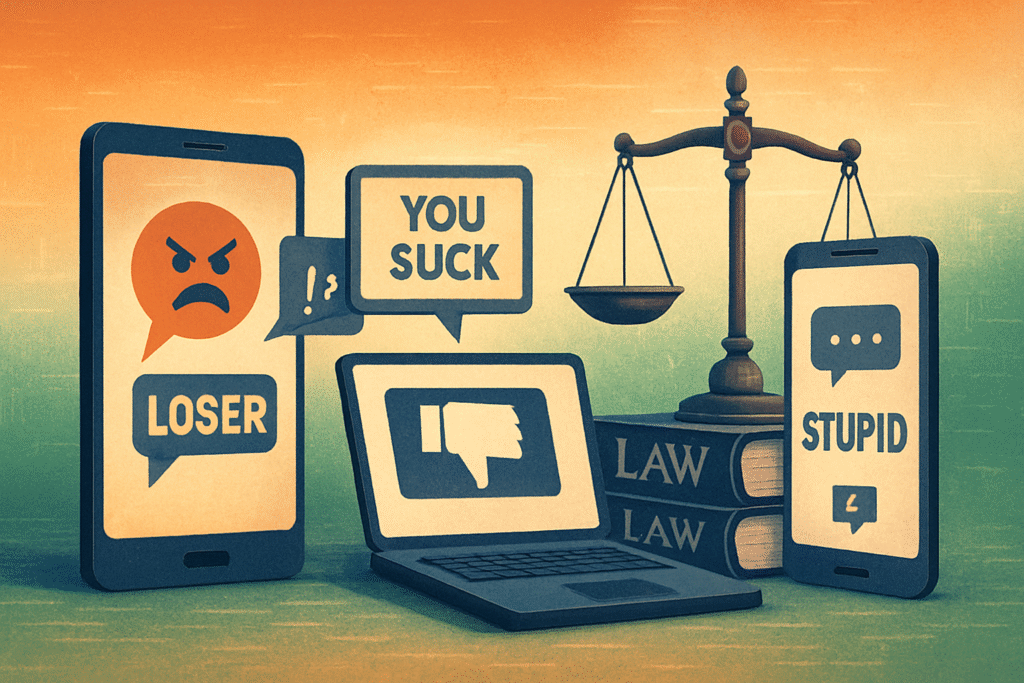
Another classic case where the Supreme Court prioritized freedom of speech and expression is Shreya Singhal v. Union of India.[5] According to Section 66A of the Information Technology Act, 2000, it was considered a crime in India to send any message via computer or mobile phone that was deemed “grossly offensive” or had “menacing character,” or to communicate information that could annoy, offend, endanger, or cause inconvenience to other people. In essence, someone may be imprisoned and sentenced to jail time if they wrote a message or posted something online that the authorities deemed offensive in nature, could cause trouble, or hurt someone’s sentiments. The issue with Section 66A was that this provision was overly broad and excessive, even reasonable or harmless criticism could be considered as illegal, suppressing free speech. As a result, there were quite many instances where people were locked up for putting jokes, cartoons, or thoughts online. Hence, in 2015, the court struck down Section 66A of the Information Technology Act, 2000, and declared it unconstitutional. By striking it down, the Court reaffirmed the freedom to express one’s opinion on digital media platform and established that the government cannot impose arbitrary rules to suppress citizens.
Understanding Hate Speech
Laws in India do not define hate speech in a way that can be universally agreed upon. Yet in general terms, hate speech is any writing, speech, or communication that mocks, criticizes, or propagates violence or hatred toward an individual or group on the ground of their religion, caste, race, gender, region, or similar other identities. Hate speech in India can cause serious society problem, including hostility, fragmentation, and damage peaceful coexistence. Although India has sufficient laws to deal with hate speech, their effectiveness is impeded by their ambiguity, inconsistent implementation, and misuse. In a diverse democracy like India, it is important to find a constitutional balance between free speech and reasonable limitations to prevent speech from being exploited as a tool to promote hatred or violence. Although no single definition exists in India, the Law Commission’s 267th report (2017) defined hate speech as an “incitement to hatred primarily against a group of persons defined in terms of race, ethnicity, gender, sexual orientation, religious belief, and the like.”
Hate speech challenges the foundational values of a constitutional democracy, such as equality, fraternity, and dignity. To preserve the fabric of a democratic society, it is essential to control its regulation. According to this report, hate speech is a complicated issue with various dimensions in Indian society. It highlights that hate speech does not limit to violent incitement but also encompasses psychological injury, exclusion, and discrimination of certain group. The Commission demands specific laws against hate speech and also observed that to determine if the content falls under hate speech, both the intent and the effect are necessary.
A significant Supreme Court judgment related to hate speech in India is Pravasi Bhalai Sangathan v. Union of India[6] (2014). In this case, the court acknowledged that in a pluralistic society like India, hate speech is dangerous and threat to national integration, individual dignity, and social harmony. Although Article 19(1)(a) of the Constitution of India guarantees the right to freedom of speech, this right is not absolute and is subject to reasonable restrictions under Article 19(2), such as those imposed in the interest of morality and public order. The Court did stress that the legislative body is responsible for enacting new laws and not the judiciary. The doctrine of separation of power falls under the basic structure of the Constitution and hence must be respected. Even though the court did not issue any new or special judicial directions, it directed the law commission to examine the issue of hate speech and recommend necessary reforms and possible new legislation in the future.
Key Statutory Provisions Against Hate Speech in India
Although hate speech is not specifically addressed by any particular legislation in India, it is still curbed by a number of provisions in different laws:
1. Constitution of India
Article 19(1)(a) safeguards freedom of speech and expression.
Article 19(2) provides grounds on which reasonable restrictions can be imposed, such as:
1. Sovereignty and integrity of India
2. Security of the state
3. Friendly relations with the foreign states
4. Public order
5. Decency or morality
6. Contempt of court
7. Defamation, and
8. Incitement of an offence
It criminalizes hate speech on constitutional basis.
2. IPC/BNS
Section 153A IPC/ 196 BNS states that any person who promotes enmity between different groups on grounds of religion, race, place of birth, residence, language, etc., or commits any act which is prejudicial to the maintenance of harmony shall be punished with imprisonment which may extend to three years, or with fine, or both.
Section 153B/ 197 BNS prohibits making claims, statements, or representations either through writing, speech, electronic means, or visible representation that are:
1. prejudicial to the integration of the country.
2. imputing that a certain group of people is incapable of having true faith or loyalty to the Indian Constitution.
3. arguing against granting a group the same rights as Indian citizens.
4. encouraging people to commit criminal offenses against a different community or class.
Section 295A IPC/ 299 BNS states that—
Whoever, with deliberate and malicious intention of outraging the religious feelings of any class of citizens of India, by words, either spoken or written, or by signs or by visible representations or through electronic means or otherwise, insults or attempts to insult the religion or the religious beliefs of that class, shall be punished with imprisonment of either description for a term which may extend to three years, or with fine, or with both.
3. Representation of People Act, 1951
Section 8 disqualifies candidates from contesting the elections who are convicted under Section 153A of IPC (offence of promoting enmity between different groups on grounds of religion, race, place of birth, residence, language, etc., and doing acts prejudicial to maintenance of harmony).
Section 123(3A) declares a corrupt practice when there is the promotion of, or attempt to promote, feelings of enmity or hatred between different classes of the citizens on the grounds of religion, race, caste, community, or language by a candidate or his agent or any other person with the consent of a candidate or his election agent for the furtherance of the prospects of the election of that candidate or for prejudicially affecting the election of any candidate.
Section 125 states that any person who, in connection with an election under this act, promotes on grounds of religion, race, caste, community, or language feelings of enmity or hatred between different classes of the citizens of India shall be punishable with imprisonment for a term that may extend to three years, or with a fine, or with both.
Effect of Digital Platforms on Regulation of Speech
With the rise of digital platforms such as Twitter/X, Meta, Instagram, YouTube, etc., the ways in which speech is expressed, shared, and absorbed have been revolutionized. While on one hand, these platforms have empowered people to freely express their ideas, thoughts, and opinions; on the other hand, they have posed legal, ethical, and technological problems and challenged the traditional methods of regulating speech.
One of the major effects of digitalization is the ‘democratization of speech.’ Earlier, mass media was limited to televisions, newspapers, or radio, which were easier for the authorities to regulate. Now, due to the accessibility of smartphones and the internet, content is now published instantly, reaching a mass audience with just one click. This has resulted in strengthening freedom of speech and expression, especially grassroots movements and marginalized voices. However, monitoring and regulating harmful speech is difficult for the government and platform because of its magnitude and speed. To address this issue, Indian government has introduced rules such as the information technology (intermediary guidelines and digital media ethics code) rules, 2021, which require intermediaries to remove unlawful content from their platforms promptly, must comply with user’s content related complaints and failure of which will make the companies liable for the illegal content, losing “safe harbour” protection. Overall, digital platforms have made speech more powerful, but they also demand strict regulation to strike a balance between personal expression and public security.
Conclusion
The core idea of democracy is where individuals are free for open dialogue, debate, and dissent without fear of being imprisoned or state suppression. Freedom of speech and expression is the root principle of democracy, but that does not mean it gives a license to hurt religious sentiment or promote communal harmony. Hate speech brings society’s dignity, harmony, and peace all at risk. Although the Indian Constitution allows reasonable restrictions, these must be properly defined, implemented fairly, and not abused to silence satire or criticism. Even, if the criticism is severe and uncomfortable yet it is an essential component of democratic freedom. However, speech that promotes violence, hatred, or prejudice is not protected. Drawing a line between constructive criticism and hateful speech is a real challenge in a diverse country like India. In order to ensure that speech is protected without inciting hatred, India needs:
• Clear definition of hate speech
• Strict enforcement of the provisions
• Judicial supervision
• Public awareness
• Regulation of online platforms
To maintain the spirit of the Indian Constitution, balancing personal liberty and social cohesion is essential.
References
[1] INDIA CONST. art. 19, cl. 1(a).
[2] INDIA CONST. art. 19, cl. 2.
[3] India Const. art. 19, cl. 2, amended by the Constitution (Sixteenth Amendment) Act, 1963.
[4] Romesh Thappar v. State of Madras, AIR 1950 SC 124.
[5] Shreya Singhal v. Union of India, (2015) 5 SCC 1.
[6] Pravasi Bhalai Sangathan v. Union of India, (2014) 11 SCC 477.
[7] https://blog.finology.in/Legal-news/hate-speech
[8] https://lawcommissionofindia.nic.in/reports/Report267.pdf
[9] https://share.google/sEYJPbh2qffJbucQo
[10] https://clpr.org.in/blog/a-little-over-the-top-examining-indias-new-laws-for-online-speech-part-i/
“`