Indian Case Law

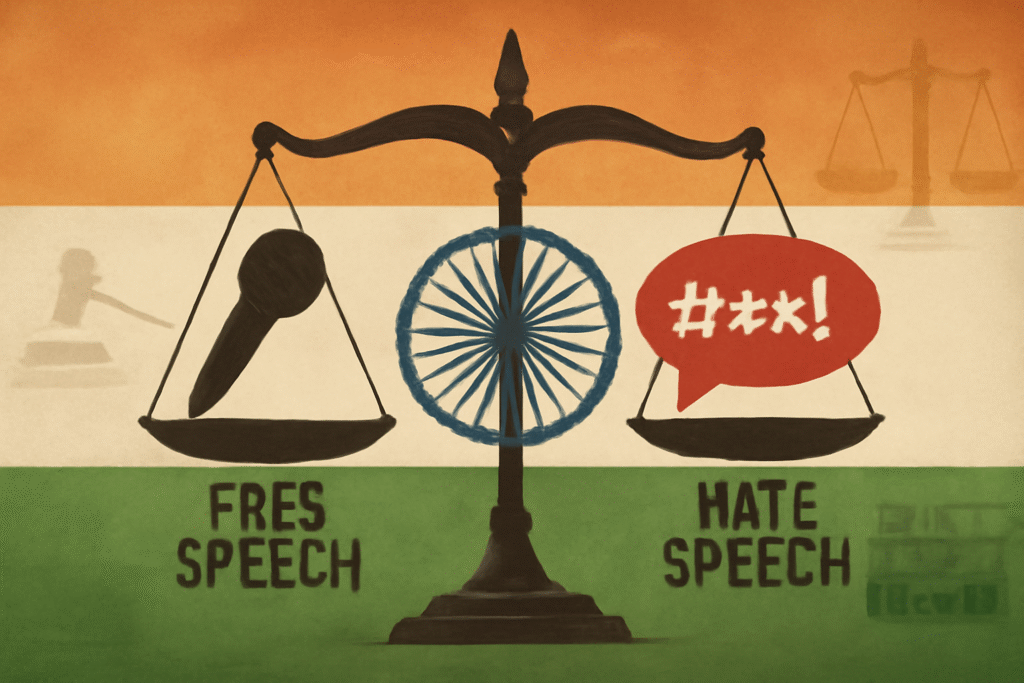
Freedom of Speech vs. Hate Speech: Finding the Constitutional Balance in India

Published On: September 19th 2025 Authored By: Kumari Rupa Faculty of Law, Lucknow University​ Abstract Free speech is a vital pillar of any democracy, but India is experiencing a proliferation of speech that generates communal and social tensions.[1] This article analyses the conflicts between the fundamental right of free speech under Article19(1)(a) of the Indian […]

Freedom of Speech vs. Hate Speech: Finding the Constitutional Balance in India Read More »

Close-up of a wooden judge's gavel on a black desk, symbolizing justice and law.

The Bharatiya Nyaya Sanhita, 2023: A Comprehensive Analysis of India’s New Criminal Code

Published On: September 19th 2025 Authored By: Anoop Kumar​ University of Lucknow 1. Introduction The Bharatiya Nyaya Sanhita, 2023 (BNS), represents a significant milestone in India’s legislative history, replacing the colonial-era Indian Penal Code, 1860 (IPC). Enacted by the Indian Parliament alongside the Bharatiya Nagarik Surak sha Sanhita (BNSS) and the Bharatiya Sakshya Adhiniyam (BSA),

The Bharatiya Nyaya Sanhita, 2023: A Comprehensive Analysis of India’s New Criminal Code Read More »

Scrabble tiles spelling 'LAW' on a wooden table, symbolizing connections to education and legality.

⁠Freedom of Speech vs. Hate Speech: Legal Balance in Indian Democracy

Published On: September 19th 2025 Authored By: Khushi Singhal IILM University, Gurugaon ABSTRACT The Indian Constitution guarantees its citizens the fundamental right to freedom of speech and expression under Article 19(1)(a), which is a cornerstone of its vibrant democracy. However, this right is not absolute and is subject to reasonable restrictions as outlined in Article

⁠Freedom of Speech vs. Hate Speech: Legal Balance in Indian Democracy Read More »

The Role of the Judiciary in Environmental Protection: A Study of Landmark Judgments

Published On: September 15th 2025 Authored By: Fatima Abdalla Cairo University, Egypt Abstract In the face of accelerating ecological crises, courts worldwide have emerged as pivotal actors in environmental governance. This article examines how judicial bodies—from domestic benches in India, Pacific, Africa, and Latin America to international tribunals—have expanded environmental norms through procedures like constitutional

The Role of the Judiciary in Environmental Protection: A Study of Landmark Judgments Read More »

Scroll to Top