indian law

Corporate Governance Reforms in India: Role of SEBI and Recent Developments

Published On: February 4th 2026 Authored By: Tejaswini Uppala Alliance University Introduction: Corporate governance refers to a framework of laws, regulations, rules, and practises under which a company is guided, administered and controlled. It outlines the relationship between the board of directors and the management, shareholders and other stakeholders in the modern day corporate law […]

Corporate Governance Reforms in India: Role of SEBI and Recent Developments Read More »
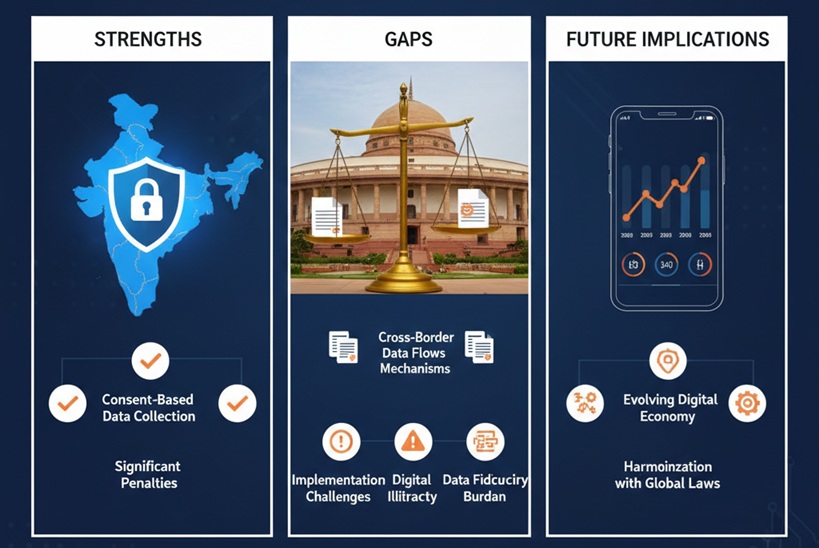
Digital Personal Data Protection Act, 2023: Strengths, Gaps, and Future Implications

Published On: February 4th 2026 Authored By: Vaishnavi Ravindra Urmode Marathwada Mitra Mandal’s Shankarrao Chavan Law College, Pune Abstract The rapid expansion of digital technologies in India has intensified the collection and processing of personal data, raising serious concerns regarding privacy, surveillance, and misuse of information. The recognition of the right to privacy as a

Digital Personal Data Protection Act, 2023: Strengths, Gaps, and Future Implications Read More »

EMPOWERING PRIVACY UNDER INDIA’S DIGITAL PERSONAL DATA PROTECTION ACT, 2023: NAVIGATING ITS STRENGTHS AND CHALLENGES 

Published On: February 4th 2026 Authored By: Urvashi Shrivastava SVKM’s NMIMS School of Law, Navi Mumbai ABSTRACT The Digital Personal Data Protection Act, 2023 (also known as the DPDP Act) is India’s regulation to balance the processing of digital personal data. It seeks to regulate privacy interests of individuals with the state and businesses’ legitimate

EMPOWERING PRIVACY UNDER INDIA’S DIGITAL PERSONAL DATA PROTECTION ACT, 2023: NAVIGATING ITS STRENGTHS AND CHALLENGES  Read More »

One Nation, One Election: Constitutional Feasibility and Federal Implications in India

Published On: February 3rd 2026 Authored By: Divyanshi IIMT University, Meerut INTRODUCTION The concept of “One Nation, One Election” means the simultaneous conduct of elections to the Lok Sabha and the State Legislative Assemblies. Under this system, elections would be held once every five years across India. It allows voters to participate in a single

One Nation, One Election: Constitutional Feasibility and Federal Implications in India Read More »

Scroll to Top