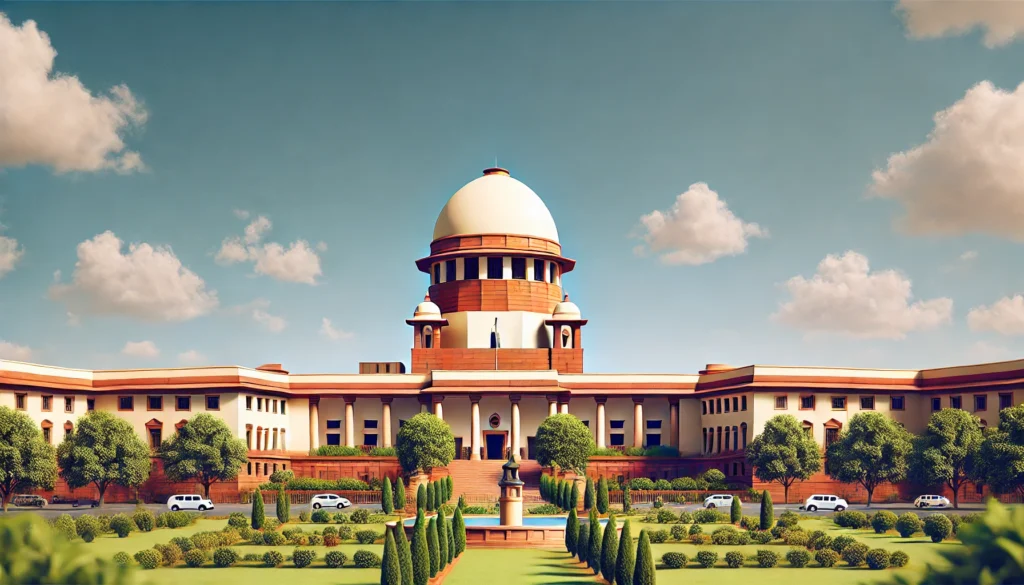
Supreme Court of India

Lady Justice figurine on wooden table in dimly lit room symbolizes law and fairness.

SHOULD INDIA BE A SECULAR COUNTRY?

Published on: 28th October 2025 Authored by: Aditi Arora University of Petroleum and Energy Studies, Dehradun Secularism, the theory of separation of the organs of the State and religious institutions, is one of the pillar of India’s constitutional democracy. The members of the Constituent Assembly had dreamt of India as a polity of many, in which the State would be equally distant and neutral to all religions, taking neither side nor intervening randomly in matters of religion, except to the extent necessary for the reason of preserving public order, […]

SHOULD INDIA BE A SECULAR COUNTRY? Read More »

hammer, books, law, dish, lawyer, paragraphs, regulation, court of justice, a book, §, code, law books, judge, order, rule, disposal, auction, law, law, law, law, law, lawyer, lawyer

Justice K.S. Puttaswamy (Retd.) v. Union of India (2017) 10 SCC 1

Published on: 26th October 2025 Authored by: Akshat Singh KR MANGALAM UNIVERSITY Nine-Judge Constitution Bench: J. Chelameswar S.A. Bobde R.K. Agrawal R.F. Nariman A.M. Sapre D.Y. Chandrachud S.K. Kaul S. Abdul Nazeer J.S. Khehar (Chief Justice of India) Date of Judgment: August 24, 2017 Key Provisions/Statutes: Article 14: Right to Equality Article 19: Freedom of

Justice K.S. Puttaswamy (Retd.) v. Union of India (2017) 10 SCC 1 Read More »

Close-up of a wooden gavel on a desk, symbolizing justice and legal authority.

Dolly Rani v. Manish Kumar Chanchal, 2024 SCC OnLine SC 754

Published on: 26th October 2025 Authored by: Shweta Bisht Faculty of Law, University of Delhi (2021-2024) INTRODUCTION A Hindu marriage is a sacrament and has a sacred character. The Hon’ble Supreme Court in this case stated that ‘a Hindu marriage is a ‘samskara’ and a sacrament which has to be accorded its status as an

Dolly Rani v. Manish Kumar Chanchal, 2024 SCC OnLine SC 754 Read More »

hammer, auction, law, justice, crime, judgement, court hearing, verdict, punishment, authority, legislation, constitution, courthouse, bid, auction, auction, auction, auction, auction, law, law, law, law, justice, judgement, judgement, court hearing, court hearing, verdict, punishment, legislation, legislation, legislation, legislation, courthouse, courthouse, courthouse

Kesavananda Bharati v. State of Kerala  AIR 1973 SC 1461; (1973) 4 SCC 225

Published on: 25th October 2025 Authored by: Aastha Shambhunath Institute of Law Court: Supreme Court of India Bench: 13-Judge Constitution Bench (Chief Justice S.M. Sikri, Justices J.M. Shelat, K.S. Hegde, A.N. Grover, A.K. Mukherjea, G.K. Mitter, K.K. Mathew, M.H. Beg, S.N. Dwivedi, Y.V. Chandrachud, P.N. Bhagwati, V.R. Krishna Iyer, and H.R. Khanna) Date of Judgement: 

Kesavananda Bharati v. State of Kerala  AIR 1973 SC 1461; (1973) 4 SCC 225 Read More »

lady justice, legal, law, justice, symbol, lawyer, balance, scale, attorney, law office, scales of justice lady, legal, legal, law, law, law, law, law, justice, lawyer, lawyer, lawyer

The Role of Judiciary in Environmental Protection: A Study of Landmark Judgments

Published on: 25th October 2025 Authored by: Aastha Shambhunath Institute of Law Abstract Environmental protection has become one of the most urgent issues of the 21st century. This makes the courts play an increasingly important role in ensuring ecological integrity through judicial activities and interpretation of environmental law. This article examines the                     transformative role of justice in environmental protection and analyzes the pioneering judgments that have shaped global environmental testing. Through a comprehensive investigation of key     cases from different jurisdictions, this study demonstrates how judicial interventions have           evolved into a proactive approach to determining the fundamental principles of environmental     law and creating precedents that continue to influence environmental governments today. Introduction The relationship between law and environmental protection has undergone major changes over    the past 50 years. The terms of the legal framework are the basis of environmental management, but it is often the judiciary that brings these laws to life by interpretation, application and enforcement. The court developed as a key judge in environmental disputes, bringing competing            benefits between development and preservation, individual rights and collective wells, and          current needs and future sustainability.The legal approach to environmental protection has evolved from a narrow, human – centric perspective to a more holistic, environmentally focused understanding. This development is particularly prominent in the pioneering judgments that not only have specific environmental conflicts but also have fundamental

The Role of Judiciary in Environmental Protection: A Study of Landmark Judgments Read More »

Scroll to Top