Published On: 17th August 2026
Authored By: Chetansi Dubey
University of Lucknow, Faculty of Law
1. CASE DETAILS
- Full Case Name: Association for Democratic Reforms and Another v. Union aof India and Others
- Citation: (2024) 5 SCC 1 / 2024 INSC 113
- Court: Supreme Court of India
- Bench: 5-Judge Constitution Bench — Dr. D.Y. Chandrachud (CJI), Sanjiv Khanna, B.R. Gavai, J.B. Pardiwala, and Manoj Misra, JJ.
- Date of Judgment: February 15, 2024
- Citation Style: Bluebook (21st Edition) / Indian Law Institute (ILI) Standard
2. FACTS & ISSUES
A. Factual Background
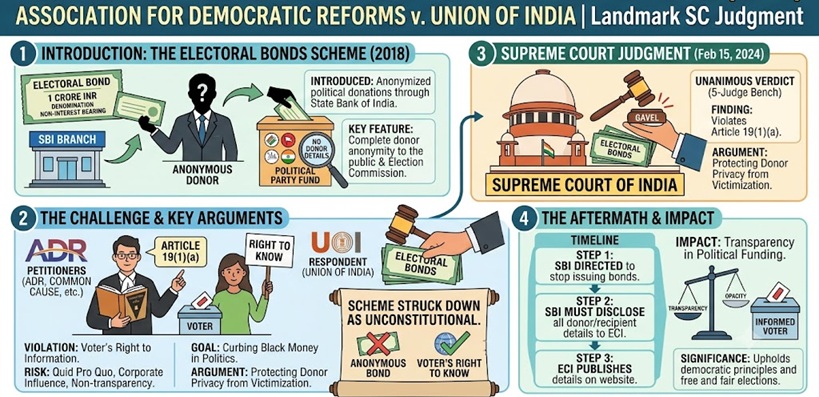
In 2017, the Government of India introduced the Electoral Bond Scheme (EBS) through the Finance Act, 2017, which amended four primary statutes: the Representation of the People Act, 1951 (RPA), the Income Tax Act, 1961, the Companies Act, 2013, and the Reserve Bank of India Act, 1934.
Under the EBS, any Indian citizen or corporate entity incorporated in India could purchase bearer bonds from authorized branches of the State Bank of India (SBI) in denominations ranging from ₹1,000 to ₹1 crore. These bonds were payable to registered political parties that had secured at least 1% of the votes polled in the last general or assembly election.
The key features of the amended scheme included:
- Anonymity: Section 29C of the RPA was amended so political parties were no longer required to report contributions received via electoral bonds, regardless of the amount.
- Removal of Corporate Donation Caps: Section 182 of the Companies Act, 2013 was amended to remove the cap on corporate political donations (previously limited to 7.5% of a company’s average net profits over the preceding three financial years). Additionally, the requirement for companies to disclose specific political party contributions in their profit-and-loss accounts was eliminated.
- Tax Exemption: Amendments to the Income Tax Act exempted political parties from maintaining records of donor identities for contributions received via electoral bonds.
Public interest petitions were filed by the Association for Democratic Reforms (ADR), Common Cause, and the Communist Party of India (Marxist), challenging the constitutional validity of the EBS and the legislative amendments on the grounds that they violated voters’ fundamental right to information under Article 19(1)(a) of the Constitution and facilitated unchecked corporate influence in elections.
B. Legal Issues Before the Court
- Whether the non-disclosure of information regarding political contributions under the Electoral Bond Scheme violates the voters’ Right to Information under Article 19(1)(a) of the Constitution of India.
- Whether unlimited corporate contributions to political parties under amended Section 182 of the Companies Act, 2013 violate the principle of free and fair elections and Article 14 of the Constitution.
- Whether the restrictions placed on the Right to Information by the Electoral Bond Scheme satisfy the test of proportionality under Article 19(2).
3. ARGUMENTS OF THE PARTIES
A. Arguments on Behalf of the Petitioners
- Violation of Fundamental Right to Information: Counsel for the petitioners argued that the right to vote meaningfully includes the right to make an informed choice. Under Article 19(1)(a), citizens have a constitutional right to know the financial sources backing political parties, as financial contributions directly influence political agendas and policy decisions.
- Corporate Influence and Quid Pro Quo: The petitioners emphasized that removing the 7.5% profit cap enabled loss-making, shell, or newly incorporated companies to channel funds to ruling political parties, creating an environment ripe for quid pro quo arrangements and corruption.
- Distinction Between Individual and Corporate Donors: It was argued that corporate donations are inherently commercial and aimed at securing policy advantages, unlike individual donations driven by ideological alignment. Treating both classes identically violates the principle of equality under Article 14.
- Failure of the Proportionality Test: The petitioners contended that curb on black money could be achieved through far less restrictive mechanisms (such as digital payments or public funding) without violating voter transparency.
B. Arguments on Behalf of the Respondents (Union of India & State Bank of India)
- Protection of Donor Privacy: The Union argued that anonymity was essential to protect donors from political retribution and harassment by rival political parties, falling under the right to informational privacy guaranteed under Article 21 (K.S. Puttaswamy v. Union of India).
- Curbing Black Money: The government maintained that the primary objective of the EBS was to incentivize banking-channel transactions for political funding, thereby curbing cash-driven black money in political campaigning.
- Legislative Competence and Policy Choice: The State submitted that economic policies and electoral reforms fall within the legislature’s domain, and judicial review should be exercised with restraint.
- Proportionality of Confidentiality: It was argued that donor privacy balanced the competing interests of transparency and protection from victimisation.
4. JUDGMENT & RATIO DECIDENDI
A. The Unanimous Decision
The 5-Judge Constitution Bench unanimously struck down the Electoral Bond Scheme, along with the corresponding amendments to the RPA, the Companies Act, 2013, and the Income Tax Act, 1961, holding them unconstitutional.
B. Ratio Decidendi
- Infringement of Article 19(1)(a): The Court held that information about political funding is essential for voters to evaluate candidates and political parties effectively. The non-disclosure of political contributions through electoral bonds directly restricts the fundamental right to freedom of speech and expression under Article 19(1)(a).
- Failure of the Doctrine of Proportionality: Applying the four-pronged test of proportionality (Legitimate Goal, Rational Connection, Least Restrictive Means, and Proportionality Stricto Sensu), the Court ruled:
- Curbing black money is a legitimate state objective, but introducing absolute donor anonymity is not the least restrictive measure to achieve it.
- Donor privacy cannot override the constitutional right of voters to know about political funding, except in narrow circumstances involving small individual contributions.
- Unconstitutionality of Unlimited Corporate Funding: The Supreme Court held the amendment to Section 182 of the Companies Act, 2013 unconstitutional. The Court recognized that corporate contributions exert a disproportionate influence on the electoral process compared to individual donations. Permitting loss-making companies and shell firms to make unlimited political contributions undermines free and fair elections and violates Article 14.
- Directions Issued: The Court directed the SBI to immediately stop issuing electoral bonds and submit full details of all electoral bonds purchased and redeemed since April 12, 2019, to the Election Commission of India (ECI) for public disclosure.
5. CRITICAL ANALYSIS
A. Constitutional Harmony: Balancing Privacy vs. Transparency
The judgment in ADR v. Union of India marks a historic milestone in Indian constitutional jurisprudence. It addresses a fundamental tension: the conflict between a donor’s right to informational privacy under Article 21 and the citizen’s right to know under Article 19(1)(a).
The Court resolved this conflict by contextualizing privacy. While individual financial contributions made out of political support warrant protection against state overreach or partisan retaliation, institutional corporate donations—which carry significant risk of political corruption and policy distortion—cannot claim the same shield of anonymity.
B. Reinforcing the Doctrine of Free and Fair Elections
Free and fair elections form an indelible part of the Basic Structure of the Indian Constitution (Indira Nehru Gandhi v. Raj Narain). By striking down the amendment to Section 182 of the Companies Act, the Court recognized the structural asymmetry caused by money power in politics. Uncapped corporate funding effectively transforms democratic politics into an oligopoly where policy decisions can be influenced by economic power rather than popular mandate.
C. Consistency with Judicial Precedents
This ruling is consistent with landmark precedents such as Union of India v. Association for Democratic Reforms (2002) and PUCL v. Union of India (2003), wherein the Supreme Court repeatedly affirmed that voters have a fundamental right to know the background, assets, liabilities, and criminal antecedents of contesting candidates. Extending this principle to party funding reinforces democratic accountability.
D. Systemic Implications and Road Ahead
While the judgment successfully eliminated an opaque financing mechanism, it highlights broader challenges in electoral finance reform:
- Alternative Anonymous Channels: Striking down electoral bonds does not automatically eliminate black money in politics; political parties may revert to cash transactions or Electoral Trusts unless robust public regulatory oversight is established.
- Institutional Accountability: The SBI’s initial resistance to disclosing donor data underscored the operational challenges of enforcement. The Court’s strict directives were necessary to ensure institutional compliance.
- Future Directions: True electoral reform will require structural legislation—such as state funding of elections, strict caps on total campaign expenditure, and an independent statutory body to monitor political finances.
6. CONCLUSION
The Supreme Court’s decision in Association for Democratic Reforms v. Union of India reaffirms that voter autonomy and transparency are core elements of Indian constitutional democracy. By invalidating the Electoral Bond Scheme, the judiciary demonstrated its commitment to protecting the democratic process from unchecked money power. The judgment establishes a vital precedent: financial opacity cannot be disguised as economic policy when it impinges upon fundamental constitutional guarantees.