
Published On: April 25, 2026
Authored By: Trisha Goyal
O. P. Jindal Global University
Case Name: Supriyo @ Supriya Chakraborty & Anr. v. Union of India
Citation: (2023) SCC OnLine SC 1348
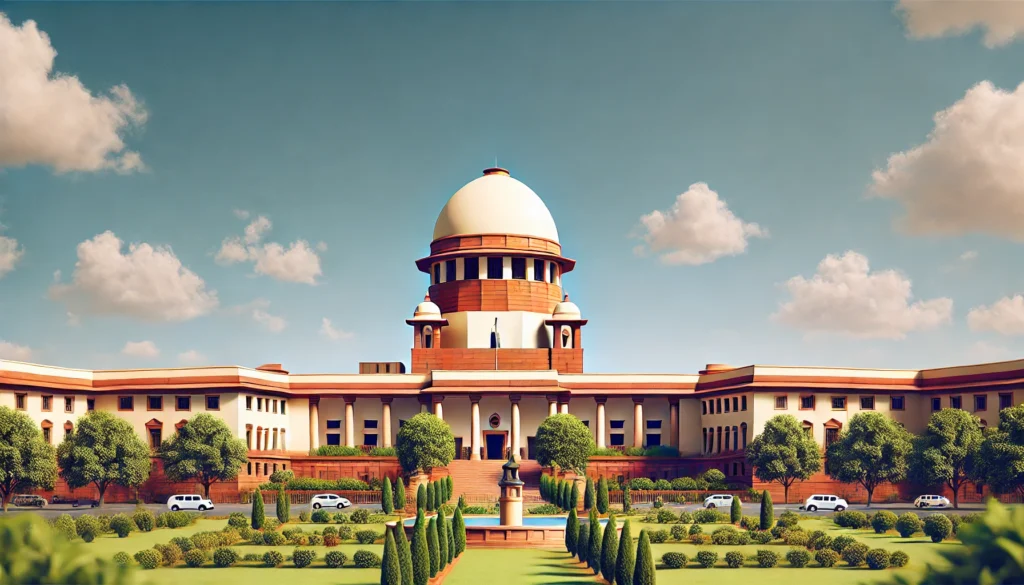
Court: Supreme Court of India
Bench: CJI D.Y. Chandrachud, J. Sanjay Kishan Kaul, J. S. Ravindra Bhat, J. Hima Kohli, and J. P.S. Narasimha
Date of Judgment: 17 October 2023
I. Facts of the Case
The petitions arose from demands seeking the legalization of same-sex marriage under Indian law. Following the landmark decision in Navtej Singh Johar v. Union of India,[1] which decriminalized consensual same-sex relations under Section 377 of the Indian Penal Code, a number of queer couples approached the Supreme Court seeking formal recognition of their right to marry.
The petitioners challenged the constitutional validity of the Special Marriage Act, 1954 (SMA),[2] the Hindu Marriage Act, 1955 (HMA),[3] and related legislation, contending that excluding same-sex couples from the institution of marriage violated Articles 14, 15, 19, and 21 of the Constitution of India.
They argued that marriage confers a host of civil entitlements, including inheritance, adoption, medical decision-making, insurance benefits, tax benefits, and next-of-kin status, all of which were being denied to them solely on the basis of their sexual orientation.
The Union Government opposed the petitions, maintaining that marriage is a socio-legal institution deeply rooted in heteronormative traditions and that any redefinition of its scope was a matter exclusively for Parliament.
II. Issues for Determination
1. Whether the refusal to recognize same-sex marriages under existing legislation violates Articles 14, 15, 19, and 21 of the Constitution.
2. Whether the Court has the power to read gender-neutral terms into the Special Marriage Act.
3. Whether there exists a fundamental right to marry under the Constitution.
4. Whether same-sex couples are entitled to ancillary rights such as adoption and recognition of civil unions.
III. Arguments Advanced
Petitioners’ Arguments
The petitioners contended that the exclusion of same-sex couples violated Article 14, as it constituted arbitrary classification based on an unintelligible differentia. They argued that discrimination on the ground of sexual orientation amounts to discrimination on the ground of sex under Article 15. They further submitted that the freedom to choose a life partner forms an essential component of personal autonomy and dignity guaranteed under Article 21.
The petitioners also invoked the Court’s precedent of expansive constitutional interpretation, citing the recognition of the right to privacy in Justice K.S. Puttaswamy (Retd.) v. Union of India[4] and the decriminalization of same-sex relations in Navtej Singh Johar, urging the Court to apply constitutional morality rather than popular social morality.
Respondents’ Arguments
The Union Government argued that marriage has historically been understood as a union between a biological man and a woman. It submitted that judicial interpretation of marriage statutes to include same-sex couples would constitute judicial legislation and would disrupt the broader framework of personal and family law. The Government further contended that no explicit fundamental right to marry exists under the Constitution and that such reform falls squarely within the legislative domain.
IV. Judgment
The Constitution Bench delivered a split verdict, with a 3:2 majority.
Majority Opinion
The majority held that the Constitution does not confer an inherent fundamental right to marry. It declined to reinterpret the Special Marriage Act to include same-sex couples, finding that to do so would amount to judicial legislation. The Court held that questions of marriage policy are matters for the legislature, not the judiciary. It further held that adoption rights are governed by statute and cannot be expanded through judicial review.
Nonetheless, the majority affirmed that LGBTQIA+ persons enjoy full constitutional protection, including the right to establish relationships and cohabit without discrimination.
Minority Opinion
The minority held that the right to choose a partner and form a union is protected under Article 21. The dissenting judges indicated that the Special Marriage Act is capable of a gender-neutral interpretation. Invoking constitutional morality, the minority favored recognition of civil unions as a means of protecting the rights of queer couples.
V. Ratio Decidendi
The binding ratio of the majority is that the Constitution does not recognize an inherent right to marry, and that reading same-sex couples into existing marriage statutes would constitute an impermissible encroachment upon the legislative sphere.
VI. Critical Analysis
The decision in Supriyo reflects a studied exercise of judicial restraint, marking a deliberate departure from the transformative constitutional approach taken in Navtej Singh Johar. Where Navtej employed constitutional morality as an active instrument of minority rights protection, the majority in Supriyo drew a firm distinction between decriminalization, a negative liberty, and the positive recognition of marriage rights, treating the latter as categorically beyond the Court’s institutional competence.
The minority’s reasoning is compelling. The dissent’s invocation of constitutional morality as a corrective to majoritarian social morality finds strong support in the Court’s own jurisprudential tradition, from Puttaswamy to Navtej. The majority’s reliance on the separation of powers, while doctrinally sound, sits uneasily alongside prior instances of judicial expansion of unenumerated rights, such as the recognition of the right to choose a partner in interfaith and intercaste contexts. The analytical inconsistency between those recognitions and the refusal to extend similar protection to same-sex couples merits closer examination.
The majority’s denial of a fundamental right to marry may also carry implications beyond this case. The Court has previously read the right to choose a marital partner as implicit in Articles 19 and 21; confining that recognition to heterosexual couples risks creating a tiered framework of constitutional rights defined by sexual orientation, an outcome that may prove difficult to reconcile with the equality guarantees of Articles 14 and 15.
That said, the majority’s affirmations of dignity, non-discrimination, and the right to cohabit represent a meaningful, if partial, advance. The judgment confirms that the state may not persecute or penalize LGBTQIA+ persons for their relationships, even as it declines to grant those relationships formal marital recognition.
VII. Conclusion
Supriyo v. Union of India is a significant moment in Indian constitutional law. The Supreme Court’s recognition that LGBTQIA+ persons are entitled to dignity, equality, and protection from discrimination reflects an important consolidation of the gains made in Navtej Singh Johar. However, the Court’s refusal to extend the right to marry, and its referral of the question to Parliament, leaves the broader framework of marriage equality unresolved.
The tension between transformative constitutionalism and institutional restraint that runs through the judgment is likely to remain a defining feature of Indian constitutional discourse in the years ahead. The future of marriage equality in India now rests, at least for the present, with the legislature. Whether Parliament chooses to act, and on what terms, will determine the practical significance of the constitutional affirmations this judgment contains.
References
[1] Navtej Singh Johar v. Union of India, (2018) 10 SCC 1.
[2] Special Marriage Act, No. 43 of 1954, INDIA CODE (1954).
[3] Hindu Marriage Act, No. 25 of 1955, INDIA CODE (1955).
[4] Justice K.S. Puttaswamy (Retd.) v. Union of India, (2017) 10 SCC 1.


![Case Summary: Donoghue v Stevenson, [1932] AC 562](https://thelegalquorum.com/wp-content/uploads/2023/06/The-Basics-of-Tort-Law-862x473-1.jpg)