Published On: July 16, 2026
Authored By: Shivam Chaurasiya
Guru Ghasidas Vishwavidyalaya, Bilaspur, Chattisgarh
Abstract
Artificial Intelligence (AI) has become an integral part of modern society, increasingly influencing sectors such as governance, healthcare, education, business, and the creative industries. Its applications range from automated decision-making systems to the generation of digital content, transforming the way individuals and institutions operate. While AI holds significant potential to enhance efficiency and drive innovation, its growing integration across sectors has raised serious legal and ethical concerns. Issues relating to transparency, accountability, algorithmic discrimination, and data privacy governance have become increasingly important, necessitating robust legal and regulatory safeguards. This article analyses the gaps in India’s current AI regulatory framework, examines recent judicial and policy developments in intellectual property and privacy law, and proposes measures for a balanced regulatory framework that promotes technological innovation while safeguarding fundamental rights.
Keywords
Artificial intelligence, data protection, intellectual property rights, AI governance, technology law, legal framework, Indian legal system.
I. Introduction
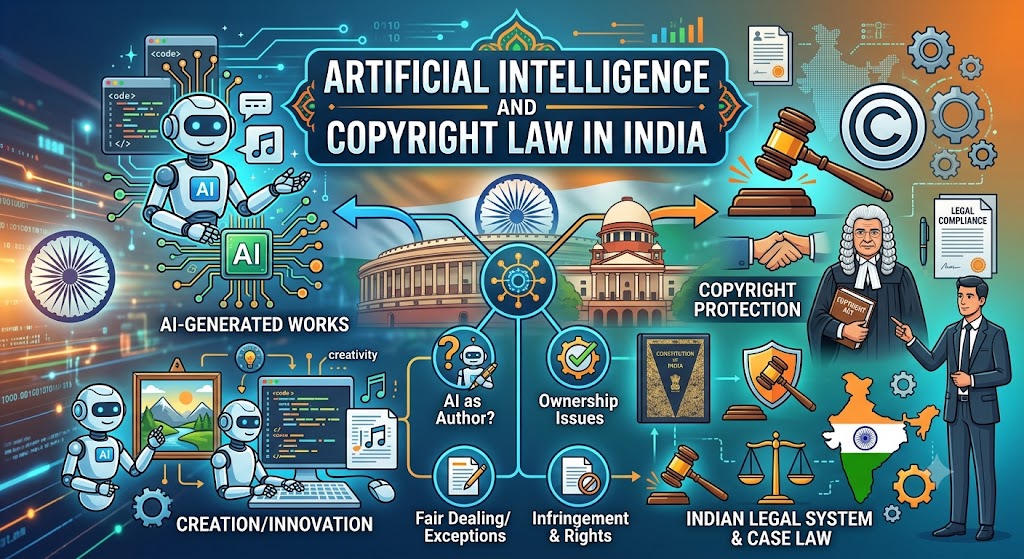
The Copyright Act, 1957 remains an important framework for addressing questions surrounding AI-generated content and the use of copyrighted works to train AI systems. As AI becomes increasingly ubiquitous across industries, India’s regulatory approach remains nascent, seeking to balance innovation with risk mitigation. In March 2024, the Union Cabinet approved the IndiaAI Mission with a budget outlay of approximately ₹10,372 crore (around USD 1.25 billion) to strengthen the country’s AI ecosystem. The Ministry of Electronics and Information Technology (MeitY) plays a leading role in this effort, formulating AI-related policy and overseeing expert committees on AI governance.
AI-powered technologies have existed in various forms since the 1960s, particularly through chatbots and automated systems, but generative AI gained widespread public attention and accessibility only with the launch of ChatGPT in November 2022. Its emergence transformed the way people communicate, work, learn, and create content, and accelerated the integration of AI tools into everyday life. While ChatGPT remains among the most widely used AI applications, several other tools — including Grammarly, DALL·E 3, and Midjourney — have also become popular for enhancing productivity and creative expression.
II. AI and Intellectual Property
The Copyright Act, 1957 plays a crucial role in regulating AI-generated content and the use of copyrighted material for AI training. Because AI systems are often trained on large datasets that may contain protected works, questions arise regarding copyright infringement and ownership. In some instances, AI-generated output may also be viewed as a derivative work,[1] creating further legal uncertainty about authorship and rights.
Commentators have suggested that Section 52 of the Copyright Act — which sets out the fair dealing exceptions — should be re-examined to clarify whether text and data mining undertaken for AI training falls within its scope.
In Thaler v Comptroller-General of Patents, Designs and Trade Marks,[2] a landmark 2023 decision, the UK Supreme Court considered whether an artificial intelligence system could be named as an inventor under the Patents Act 1977. The Court held that only a natural person can be recognised as an inventor for the purposes of obtaining a patent.
The protection of intellectual creations is a foundational aspect of copyright law: authors and creators hold exclusive rights over the use, reproduction, distribution, and adaptation of their original works.[3] The emergence of Artificial Intelligence has introduced new challenges to these rights. AI systems are typically trained on extensive datasets drawn from various digital sources, many of which may contain copyrighted material — including books, articles, software code, images, music, and artistic works. In several instances, such material has been incorporated into training datasets without the prior authorisation of rights holders. This practice has raised significant legal and ethical concerns relating to copyright ownership, unauthorised use, and the scope of existing intellectual property protections. There is consequently a growing need for a balanced legal framework that safeguards creators’ rights while encouraging technological innovation and the responsible development of AI.
III. AI, Intellectual Property Infringement, and the Right to Privacy
Personality rights are protected as a facet of intellectual property law. In Aishwarya Rai Bachchan v Aishwaryaworld.com & Ors,[4] the Delhi High Court considered a claim brought by actor Aishwarya Rai Bachchan against several websites selling merchandise bearing her image and disseminating AI-morphed images and deepfake videos of her. Counsel for the defendants argued that such use was protected under the right to freedom of speech and expression. The Court rejected this argument, holding that the unauthorised use amounted not only to a violation of personality rights but also to a violation of the fundamental right to life with dignity, which is associated with the right to privacy. In reaching this conclusion, the Court drew on precedents including Amitabh Bachchan v Rajat Negi,[5] Anil Kapoor v Simply Life India & Ors,[6] ICC Development (International) Ltd v Arvee Enterprises,[7] DM Entertainment (P) Ltd v Baby Gift House,[8] Titan Industries Ltd v Ramkumar Jewellers,[9] and Gautam Gambhir v D.A.P. & Co.[10] Justice Tejas Karia observed:
“The unauthorised exploitation of the attributes of an individual’s personality may have two facets — first, violation of their right to protect their personality attributes from being commercially exploited; and second, such actions may infringe an individual’s privacy rights and consequently affect their ability to live with dignity.”
This reasoning draws on the broader principle that the freedom of speech and expression under Article 19(1)(a) is not absolute and may be restricted on the grounds set out in Article 19(2), including decency and morality — grounds interpreted narrowly by the Supreme Court in cases such as Shreya Singhal v Union of India.[11] Those grounds are particularly relevant here because the images of Rai were, in part, used to generate deepfake and pornographic content.
In Ranjit D. Udeshi v State of Maharashtra,[12] the Supreme Court addressed the standard for obscenity and adopted the “Hicklin test” to define public morality. That test was later replaced by the “community standards test” in Aveek Sarkar v State of West Bengal.[13] Section 292 of the Indian Penal Code, 1860 (now Section 294 of the Bharatiya Nyaya Sanhita, 2023) criminalises the circulation of obscene material.
A second question before the Court was whether such conduct also violated the right to privacy under Article 21. The right to privacy was recognised as a fundamental right in K.S. Puttaswamy (Retd.) v Union of India.[14] Earlier privacy jurisprudence had already recognised privacy interests in specific contexts, including Kharak Singh v State of Uttar Pradesh[15] and People’s Union for Civil Liberties (PUCL) v Union of India.[16] Related authorities include State of Maharashtra v Madhukar Narayan Mardikar,[17] in which the Supreme Court affirmed that the right to privacy applies to every individual regardless of background, and R. Rajagopal v State of Tamil Nadu,[18] in which the Court held that the unauthorised publication of details of a person’s private life violates the right to privacy, balancing Article 19(1) against Article 21.
In a related matter, the Delhi High Court set aside a 2016 order of the Central Information Commission (CIC) that had directed Delhi University to disclose details of Prime Minister Narendra Modi’s bachelor’s degree in response to an RTI application. The Court held that disclosure of academic records without justification interferes with an individual’s private sphere and may violate the right to privacy, and that information such as degrees, mark sheets, admit cards, answer sheets, and grades falls within “personal information” under Section 8(1)(j) of the Right to Information Act, 2005.*
The well-established legal maxim ex injuria jus non oritur — that a legal right cannot arise from an unlawful act — is instructive here. Because the unauthorised use of an individual’s image is itself unlawful, a defendant cannot invoke the right to freedom of speech and expression to justify it.
IV. Liability and Accountability in Deployment
The Information Technology Act, 2000 continues to serve as India’s primary legal framework governing digital activity; however, its provisions predate the emergence of advanced AI technologies and therefore offer only limited guidance on AI-specific issues. Certain provisions — such as those addressing online fraud, identity theft, and deceptive digital practices — can be applied to harms caused by AI-generated content, including deepfakes and synthetic media, and intermediary platforms are required to exercise due diligence to prevent the dissemination of unlawful content.
Despite these safeguards, significant uncertainty remains regarding accountability for autonomous AI systems capable of generating, modifying, or disseminating content with minimal human intervention. The India AI Governance Guidelines, released by MeitY in November 2025, advocate a comprehensive regulatory framework that clearly identifies the roles and responsibilities of AI developers, deployers, and end users. The framework emphasises transparency, risk management, ethical deployment, and shared liability, aiming to promote innovation while ensuring that AI technologies operate within a robust system of legal and ethical accountability.
V. Conclusion
The role of AI is set to expand rapidly across all sectors of Indian life, and it will inevitably affect intellectual property rights, particularly copyright. Artificial intelligence systems should not be denied all protection under IP law solely on the basis that they are not legal persons; rather, India’s regulatory framework should evolve to address the questions of authorship, ownership, and accountability that are specific to AI-generated works.
References
[1] R.G. Anand v Delux Films, (1978) 4 SCC 118.
[2] Thaler v Comptroller-General of Patents, Designs and Trade Marks, [2023] UKSC 49.
[3] Eastern Book Company v D.B. Modak, (2008) 1 SCC 1.
[4] Aishwarya Rai Bachchan v Aishwaryaworld.com & Ors, 2025 SCC OnLine Del 5943 (order dated 9 September 2025).
[5] Amitabh Bachchan v Rajat Negi, (2022) 6 HCC (Del) 641.
[6] Anil Kapoor v Simply Life India & Ors, 2023 SCC OnLine Del 6914.
[7] ICC Development (International) Ltd v Arvee Enterprises, 2003 SCC OnLine Del 943.
[8] DM Entertainment (P) Ltd v Baby Gift House, 2010 SCC OnLine Del 4790.
[9] Titan Industries Ltd v Ramkumar Jewellers, 2012 SCC OnLine Del 2382.
[10] Gautam Gambhir v D.A.P. & Co., 2017 SCC OnLine Del 12130.
[11] Shreya Singhal v Union of India, (2015) 5 SCC 1.
[12] Ranjit D. Udeshi v State of Maharashtra, AIR 1965 SC 881.
[13] Aveek Sarkar v State of West Bengal, (2014) 4 SCC 257.
[14] Justice K.S. Puttaswamy (Retd.) v Union of India, (2017) 10 SCC 1.
[15] Kharak Singh v State of Uttar Pradesh, AIR 1963 SC 1295.
[16] People’s Union for Civil Liberties (PUCL) v Union of India, (1997) 1 SCC 301.
[17] State of Maharashtra v Madhukar Narayan Mardikar, (1991) 1 SCC 57.
[18] R. Rajagopal v State of Tamil Nadu, (1994) 6 SCC 632.