Published On: June 19, 2026
Authored By: Mutahira Afifa
St Joseph's College of Law
Abstract
Marital rape continues to be one of the most contested questions in Indian criminal law. Although consent and personal autonomy are recognised as fundamental constitutional values, forced sexual relations within marriage are, in general, excluded from the legal definition of rape under Indian criminal law.
The exemption from rape under Exception 2 to Section 375 of the Indian Penal Code, and its continuation under Section 63 of the Bharatiya Nyaya Sanhita, 2023,[1] reveal the persistence of patriarchal conceptions of law rooted in colonial jurisprudence. This paper examines the conflict between the doctrine of marital immunity and the constitutional guarantees under Articles 14, 19, and 21, and considers the arguments made in favour of and against criminalisation. It also analyses key judgments, including Independent Thought v. Union of India[2] and Joseph Shine v. Union of India,[3] alongside comparative legal developments in the United Kingdom, Canada, Australia, and South Africa. The paper further considers how the marital rape exception is inconsistent with the way individuals experience equality, dignity, and bodily integrity, and discusses its psychological, physical, and societal effects on victims. It concludes with recommendations for legislative and procedural reform.
Keywords: Marital Rape, Consent, Constitutional Rights, Human Dignity, Feminist Jurisprudence, Gender Justice.
I. Introduction
Meaning and Concept of Marital Rape
Marital rape refers to sexual intercourse between a husband and wife without the wife’s consent, where the husband forces or coerces her into sexual activity against her will. In general, non-consensual sexual intercourse is treated as rape; traditionally, however, marital rape was not recognised as such, on the assumption that a wife consents to sex for the duration of the marriage once she marries.
This assumption held that a husband could never be guilty of forcing himself on his wife, since wives were presumed to consent permanently to sexual relations through marriage. Sir Matthew Hale articulated this view, stating that it was therefore impossible for a husband to rape his wife. This doctrine had a significant impact on the development of criminal law during the colonial era, particularly as it shaped criminal courts in India.
Over time, however, the concept of consent has evolved, and marriage is increasingly understood as a partnership of equals rather than a relationship in which one party is “owned” by the other. Despite this evolution, Indian law continues to contain provisions that shield a husband from criminal liability for non-consensual intercourse with his wife, even decades after India adopted its Constitution in 1950. The continued legal tolerance of a husband’s sexual access to his wife, irrespective of her consent, raises serious human rights and gender justice concerns within India’s criminal law framework.
While several provisions of the Indian Penal Code recognise domestic and sexual abuse as forms of domestic violence, the failure to criminalise non-consensual intercourse within marriage leaves married women without an effective criminal remedy against their husbands. Judicial interpretation on this question has also been inconsistent, compounding the constitutional and legal controversy surrounding the issue.
As awareness of women’s rights continues to grow, pressure for legal reform on marital rape has intensified. Many jurisdictions now criminalise marital rape, rejecting the presumption that marriage implies permanent consent to sex. Legal scholars, women’s rights advocates, and members of the judiciary in India have increasingly called for the removal of the marital rape exemption and for greater emphasis on consent within marriage.
Examining the legal status of marital rape is therefore essential to assessing whether India’s current criminal law adequately protects married women.
II. Historical Background
Historically, a married woman had no legal identity separate from her husband. Under the common law doctrine of coverture, a wife was considered legally merged with her husband, and the law accordingly did not recognise marital rape as an offence.
Section 375(2) of the Indian Penal Code, 1860, reflected this colonial legacy by providing that sexual intercourse by a man with his wife, without force, did not constitute rape if she was above a specified age. This age threshold changed over time through legislative and judicial intervention. Initially set at fifteen years, it was later raised to eighteen years by the Supreme Court in Independent Thought v. Union of India.[2]
Despite these incremental changes, husbands remain largely protected from prosecution for non-consensual intercourse with their wives. This protection has its roots in the colonial period: the Indian Penal Code, enacted in 1860, defined rape under Section 375 as intercourse without consent, but carved out an exception for husbands having sex with their wives above a specified age. This framework reflected a view of wives as subject to their husbands’ control, with little regard for whether the wife actually consented. Because child marriage was common at the time and the relevant age threshold was very low, the law offered minimal protection to married women and treated wives more as property than as individuals capable of exercising choice, a legacy that continues to shape attitudes toward marriage and consent in India today.
As social reform movements and early feminist thought began to challenge these assumptions, the case of Phulmoni Dasi became a turning point. In 1889, an eleven-year-old girl died after sexual intercourse with her husband, sparking national outrage. In response, the Age of Consent Act, 1891,[4] was enacted, raising the age below which intercourse with a wife was deemed rape. The exception for marital rape, however, remained intact.
III. Research Problem
This paper examines whether the continuing impunity accorded to marital rape constitutes an infringement of fundamental principles of equality, dignity, bodily autonomy, and liberty. It also assesses whether India’s criminal justice system effectively protects married women from sexual violence within marriage.
IV. Objectives of the Study
1. To explore the legal status of marital rape under Indian law.
2. To analyse the constitutional issues raised by the marital rape exception.
3. To review judicial opinion on consent and marital privilege.
4. To compare Indian law with foreign jurisdictions on this issue.
5. To identify legislative loopholes and gaps.
6. To propose recommendations for reform.
V. Section 375 of the Indian Penal Code
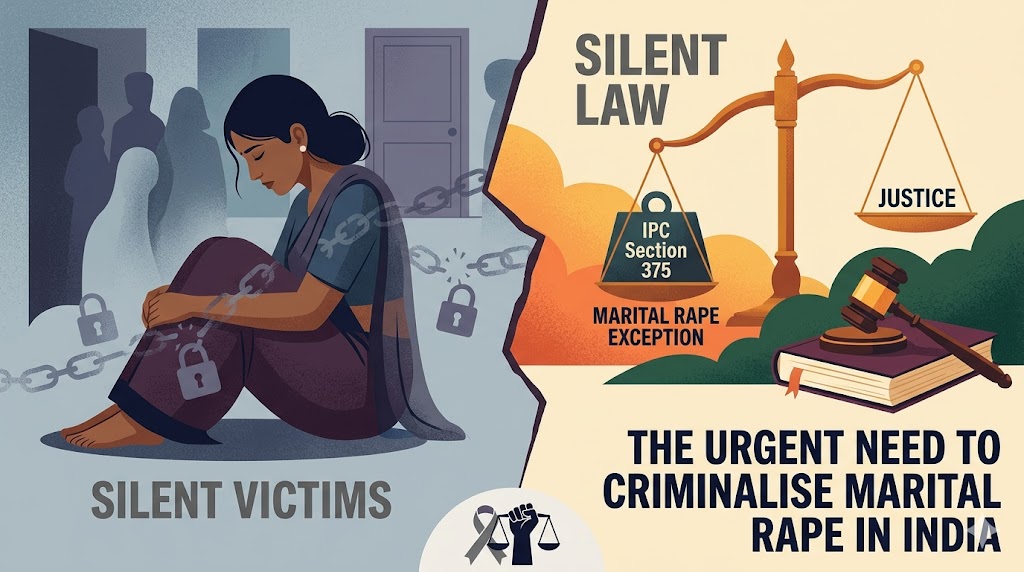
Section 375 of the Indian Penal Code defined rape and identified the circumstances in which consent is absent or invalid. Under this provision, rape was established whenever a man engaged in sexual intercourse with a woman without her consent. Exception 2 to the section, however, provided that intercourse by a man with his own wife did not constitute rape, provided she had attained a specified age.
Section 375 of the IPC provided that a man is said to commit rape if he engages in sexual intercourse with a woman under any of the following circumstances:
i. Against her will.
ii. Without her consent.
iii. With her consent, where consent has been obtained by putting her or any person in whom she is interested in fear of death or hurt.
iv. With her consent, when she is unable to understand the nature and consequences of the act due to unsoundness of mind, intoxication, or the administration of any stupefying or unwholesome substance.
v. With her consent, when she is under eighteen years of age.
vi. When she is unable to communicate consent.
Section 375 clarified that consent meant an unequivocal, voluntary agreement communicated through words, gestures, or any other form of verbal or non-verbal communication, and that the absence of physical resistance could not, by itself, be equated with consent.
VI. Bharatiya Nyaya Sanhita and Continuation of the Exception
The enactment of the Bharatiya Nyaya Sanhita, 2023, formed part of a broader effort to reform India’s criminal laws. However, the marital rape exemption survived this reform almost unchanged, now appearing as Exception 2 to Section 63 of the BNS.[1] Critics argue that although the new code replaces the colonial-era statute in form, it carries forward the same colonial patriarchal assumptions in substance.
The retention of this exemption has drawn criticism from feminist groups as well as legal and constitutional scholars. A critical analysis of the present legal position suggests that it is inconsistent with the constitutional values of equality, dignity, and personal liberty guaranteed under Articles 14, 15, and 21 of the Constitution of India.
The exception creates an unreasonable distinction between married and unmarried women and weakens the protection available to victims of sexual violence within marriage. Although laws such as the Protection of Women from Domestic Violence Act, 2005, provide civil remedies for sexual abuse, the absence of criminal recognition leaves a significant gap in ensuring justice and accountability.
The growing demand for legal reform reflects shifting societal perceptions of marriage, consent, and women’s rights. International human rights standards and comparative legal developments in other jurisdictions further support the criminalisation of marital rape. Recommendations from legal experts, women’s organisations, and bodies such as the Justice Verma Committee underscore the urgent need for criminal law reform to protect women from violence regardless of marital status. Criminalising marital rape, therefore, does not amount to an attack on the institution of marriage, but rather a step toward mutual respect, equality, and human dignity within marriage. Such reform would strengthen women’s rights, reinforce constitutional morality, and contribute to a more just society.
Article 19
The freedom of speech and expression has been read to include decisional autonomy and freedom over one’s own body.
Article 21
Article 21 protects the right to life and personal liberty, which encompasses dignity, privacy, bodily integrity, and autonomy. The Supreme Court has firmly established that consent and bodily integrity are intrinsic elements of human dignity.
VII. Judicial Trends and Evolving Jurisprudence
Independent Thought v. Union of India[2]
This landmark judgment addressed the conflict between child marriage protections and the marital rape exemption. The Supreme Court held that sexual intercourse with one’s wife when she is under eighteen years of age constitutes rape.
The Court made clear that marriage is no defence for harming a minor. While the decision did not criminalise marital rape generally, it marked a significant step toward dismantling the broader notion of marital immunity that has historically shielded husbands from accountability for sexual violence against their wives. The judgment was grounded in constitutional morality and prioritised child rights over outdated social norms.
Joseph Shine v. Union of India[3]
In Joseph Shine, the Supreme Court struck down the adultery provision under Section 497 of the IPC. The judgment emphasised respect, autonomy, and equality within marriage, and rejected the underlying assumption that a husband holds proprietary rights over his wife. Commentators have noted that the reasoning in Joseph Shine undermines the very logic that sustains the marital rape exception.
Justice K.S. Puttaswamy v. Union of India[5]
This judgment recognised privacy as a fundamental right under Article 21 of the Constitution. The Court affirmed bodily autonomy, personal liberty, and dignity as core constitutional values, principles with direct bearing on the question of consent within marriage.
Delhi High Court Split Verdict[6]
The Delhi High Court delivered a split verdict on a constitutional challenge to the marital rape exception. One judge held the provision unconstitutional, while the other upheld its validity. This division underscored the contested and unsettled nature of the issue, which remains pending before the Supreme Court of India.
VIII. Comparative Analysis with Foreign Jurisdictions
United Kingdom
Marital rape immunity was abolished in the United Kingdom following R v. R,[7] in which the House of Lords held that marriage does not entail unconditional, irrevocable consent to sexual intercourse. The decision recognised marriage as a partnership of equals.
Canada
Canada’s Criminal Code abolished the marital rape exemption in 1983, ensuring that sexual violence is treated consistently regardless of marital status.
Australia
Australian states progressively repealed marital rape immunity between the 1970s and 1990s, reflecting growing recognition of women’s rights.
South Africa
South Africa criminalised marital rape and affirmed gender equality as a constitutional value, supported by a legal system that emphasises dignity and bodily integrity.
International Trends
More than one hundred countries have criminalised marital rape. India’s continued failure to do so places it at odds with evolving international human rights standards, including its obligations under the Convention on the Elimination of All Forms of Discrimination Against Women (CEDAW), which requires member states to eliminate discrimination against women. International bodies have repeatedly called on India to criminalise marital rape.
Universal Declaration of Human Rights
The Universal Declaration of Human Rights affirms that all individuals are entitled to equal rights, dignity, and freedom from degrading treatment.
International Covenant on Civil and Political Rights
The Covenant guarantees every individual’s personal freedom and bodily integrity.
United Nations Recommendations
Several United Nations treaty bodies have recommended that marital exemptions to rape laws be abolished globally.
IX. Socio-Legal Impact of Marital Rape
Impact on Women’s Mental Health: Victims may experience depression, trauma, fear, insomnia, and social alienation as a result of marital sexual violence.
Economic Dependence and Vulnerability: Many women are economically dependent on their husbands, making it difficult to leave abusive marriages. Societal stigma further discourages victims from raising such issues or accessing justice.
Effects on Family Relations: Children exposed to sexual and domestic violence within the household often experience lasting psychological harm.
Social Silence and Patriarchy: Within patriarchal social structures, marital rape is often normalised, while limited public awareness of the law contributes to significant underreporting.
X. Need for Legal Reform
Removal of the Marital Rape Exception
The foremost requirement for reform is the removal of the marital rape exception from criminal law. Consent must remain central regardless of marital status.
Gender-Sensitive Investigation
Police and judicial officers require specific training to handle cases of marital sexual violence sensitively and effectively.
Safeguards Against Misuse
Procedural safeguards, including preliminary inquiry, mediation in appropriate non-violent cases, and penalties for malicious litigation — should be considered to address concerns about misuse.
Awareness and Education
Public awareness campaigns are necessary to shift social attitudes toward consent within marriage.
Victim Support Mechanisms
Counselling services, shelter homes, legal aid, and rehabilitation programs for survivors should be strengthened and expanded.
XI. Conclusion
The issue of marital rape sits at the intersection of constitutional morality, criminal law, gender equality, and human rights. The persistence of the marital rape exception reflects archaic patriarchal assumptions that have no place in modern constitutional discourse. Marriage cannot serve as a license for non-consensual sexual intercourse; bodily autonomy and dignity do not lapse upon marriage. Denying married women the same legal protection extended to others is fundamentally inconsistent with the principle of equality before the law.
Indian courts have repeatedly affirmed the right to make personal decisions, to privacy, and to be treated with dignity as core constitutional values. These principles are reinforced by international human rights standards and the growing global consensus that marital rape should be criminalised. At the same time, legitimate concerns — such as the risk of false accusations or evidentiary difficulties, must be addressed through balanced legislation, appropriate procedural safeguards, judicial sensitivity, and robust victim protection measures.
A critical examination of the current legal regime demonstrates that it fails to uphold the constitutional values of equality, dignity, and personal liberty enshrined under Articles 14, 15, and 21 of the Constitution of India. The legal distinction between married and unmarried women leaves married victims of sexual violence disproportionately vulnerable. While civil remedies, such as those available under the Protection of Women from Domestic Violence Act, 2005, offer some recourse, the absence of a criminal remedy for sexual abuse within marriage leaves a significant gap in the law.
Changing societal attitudes toward marriage, consent, and women’s status, both in India and internationally, continue to build the case for reform. International human rights law and comparative legal developments in other countries further reinforce this position. The marital rape exception is rooted in outdated, patriarchal assumptions that have no place in a modern constitutional democracy. Legal scholars, women’s rights organisations, and bodies such as the Justice Verma Committee have consistently called for reform of India’s criminal law to protect women from violence, irrespective of marital status.
Recognising marital rape as a criminal offence would not undermine the institution of marriage; rather, it would affirm that equality and mutual respect are foundational to it. Such reform is essential not only to protect women, but to ensure that India’s laws genuinely reflect its constitutional commitment to equality, dignity, and justice for all.
“Ultimately, a just legal system must recognise that consent, dignity, and equality do not end with marriage.”
References
[1] The Bharatiya Nyaya Sanhita, 2023, No. 45 of 2023, § 63, Exception 2 (India); Indian Penal Code, 1860, No. 45 of 1860, § 375, Exception 2 (India) (repealed 2024).
[2] Independent Thought v. Union of India, (2017) 10 SCC 800 (India).
[3] Joseph Shine v. Union of India, (2019) 3 SCC 39 (India).
[4] The Age of Consent Act, 1891, No. 10 of 1891 (India).
[5] Justice K.S. Puttaswamy (Retd.) v. Union of India, (2017) 10 SCC 1 (India).
[6] RIT Foundation v. Union of India, 2022 SCC OnLine Del 1404 (Delhi High Court, India).
[7] R v. R, [1992] 1 AC 599 (HL) (UK).